Yin — Book Summary & Review
Last updated:
Yin Summary
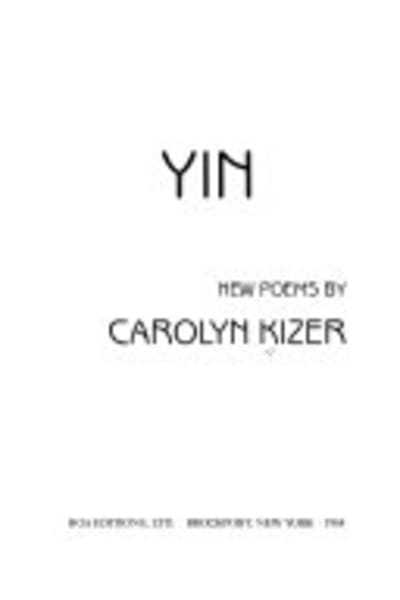
Carolyn Kizer’s Yin is organized around the speaker’s insistence that “feminine” perception is not a decorative theme but a way of seeing, feeling, and making—especially when creativity is treated like an accessory. The slim 85-page book (a single, tightly focused volume) keeps returning to one core tension: women are often asked to translate their inner lives into “acceptable” forms, while Kizer argues that the inner life is already a craft site. Across the poems, she uses recurring images of bodies, breath, domestic spaces, and labor to show how imagination grows from the ordinary rather than from permission. You can feel her discipline in how she refuses to let tenderness float free of power; the book keeps insisting that softness can carry force, and that creative ability is inseparable from how femininity gets policed.
Kizer’s title Yin matters here—not as a philosophy trivia word, but as a working metaphor for receptivity, convergence, and the kind of attention that doesn’t force everything into a single masculine timeline. In poems that circle around the act of writing, she treats creativity as something that listens first, then shapes. One limitation is that Yin doesn’t broaden into a full “theory of women’s art” with arguments you can quote in a workshop; it’s lyric, not explanatory, so if you want prose-style persuasion, you’ll feel the gaps.
What you get instead is a sustained atmosphere: the book’s best poems make you sit with the friction between self-definition and social expectation, and they do it with images that stay practical—hands, rooms, work—rather than turning purely symbolic. If you’re willing to read Kizer slowly, Yin leaves you with a bracing sense that creative ability is not a talent lottery; it’s a way of paying attention that can be reclaimed.
Key Takeaways from Yin
-
1
Yin as method: receptivity and listening become a creative practice, not a vague mood or philosophy label.
-
2
Feminine perceptions: Kizer treats “feminine” experience as a legitimate lens with its own authority and consequences.
-
3
Creativity as bodily attention: imagination is rooted in breath, labor, and the physical details of everyday life.
-
4
Self-definition under pressure: poems track how social expectations try to edit women’s inner worlds into safer shapes.
-
5
Lyric refusal of explanation: Kizer prioritizes atmosphere and image over thesis statements you can easily extract.
Who Should Read This
Someone who’s tired of “women and art” arguments that sound like slogans and wants poetry that makes femininity feel like a real creative engine. If you’re in a rough patch where your writing or making feels blocked by other people’s expectations, Kizer’s Yin will meet that friction head-on.
Who Shouldn't Read This
If you want a structured, prose-like argument with clear takeaways and workshop-ready guidance, Yin will frustrate you with its lyric density. If you only like poetry that’s outwardly narrative and plot-driven, Kizer’s inward, image-heavy approach may feel too atmospheric for your taste.
Editor's Verdict
The single best thing Yin does is insist that “feminine” perception is craft itself—especially through Kizer’s recurring focus on listening attention as the engine of imagination. The limitation is that it never becomes an explanatory manifesto; you’re asked to live inside the images rather than extract a system. This hits hardest for anyone who’s mid-creative life and suddenly resents how their work keeps being evaluated through someone else’s idea of femininity.
Ready to read Yin?
Get your copy on Amazon today.
Yin — Frequently Asked Questions
About Carolyn Kizer
Carolyn Kizer (1922–2014) was an American poet and essayist. She was trained in literature and taught writing, and her work often drew on Eastern philosophy and contemplative practice, making her credible for writing about yin and related ideas. Her poetry collections include The House of the Bride and The Singing Bowl. She also published essays and other volumes exploring spirituality and the inner life.