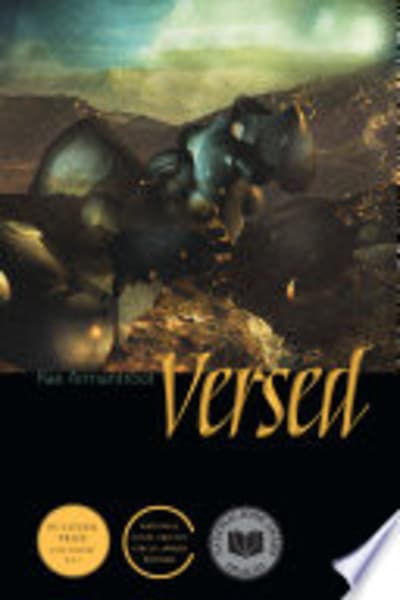
Versed — Book Summary & Review
Last updated:
Versed Summary
In Versed, Rae Armantrout builds a recurring method she calls “versing”: the poem behaves like a thought you’re trying to catch mid-flight, then it keeps slipping away. The book is slim, but it doesn’t feel light; it feels calibrated. Armantrout repeatedly sets up expectations—about clarity, about lyric emotion, about the clean line between “meaning” and “noise”—and then she tests what happens when those expectations fail. What I kept noticing is how Versed uses everyday registers (advertising syntax, news cadence, classroom talk) and turns them into pressure points, so the reader has to do real work instead of consuming a mood.
One of the most concrete anchors is the poem sequence “Versed,” where Armantrout lets language sound almost conversational while quietly tightening the screws: pronouns wobble, logic fractures, and the poem’s “I” becomes less a speaker than a lens. Later, the book’s attention to perception and misperception sharpens in poems that feel like they’re arguing with themselves—Armantrout’s lines don’t just describe a moment; they show the mind manufacturing the moment while insisting it’s only reporting it. Even when the subject matter is small, the method is consistent: the poem refuses to settle into a single stable interpretation.
A limitation: Versed won’t be satisfying if you want narrative momentum or emotional catharsis. Some poems end with a kind of intellectual shrug—more “here’s the mechanism” than “here’s the payoff.” If you’re hunting for accessible confessional clarity, Armantrout’s precision will feel cold or evasive rather than liberating.
Key Takeaways from Versed
-
1
Versing: Armantrout treats poems like thinking-in-motion, where meaning changes as soon as you try to pin it down.
-
2
Pronoun wobble: She uses shifting “I/you” reference to show how identity is constructed, not simply stated.
-
3
Everyday syntax pressure: Commercial and news-like phrasing becomes a stress test for how language manufactures “facts.”
-
4
Sequence “Versed”: The title sequence models the book’s method—expect clarity, then watch it fail on the page.
-
5
Mind-as-reporter: Armantrout frames perception as a production process, not a passive window.
Who Should Read This
Someone who’s been rereading the same old poems looking for a fresh way to think about language will likely latch onto Versed. If you’re currently stuck in over-explaining everything—your feelings, your politics, your theories—Armantrout’s poems will disrupt that reflex.
Who Shouldn't Read This
If you need a strong emotional arc or a speaker you can trust to deliver a stable message, Versed will frustrate you. If you want lyrical comfort with clear payoff, Armantrout’s method can feel like refusing the handhold on purpose.
Editor's Verdict
The best thing Versed does is turn the title-sequence “Versed” into a working model of how thought and language collide, especially through its destabilized voice and tightening syntax. The real limitation is that it offers little narrative momentum or cathartic release, so you may feel stalled rather than moved. This hits hardest for anyone who’s mid-career and tired of “clarity” as a performance—when you want language to show its seams instead of pretending it’s seamless.
Ready to read Versed?
Get your copy on Amazon today.
Versed — Frequently Asked Questions
About Rae Armantrout
Rae Armantrout (born 1947) is an American poet and professor. She has taught at the University of California, San Diego, and is known for concise, innovative poetry that draws on philosophy, language, and perception. She is credible on writing about “versed” forms and contemporary poetry because her career centers on close attention to how language works in verse. Other notable works include To the Lighthouse (2012) and The Pretext (2001).