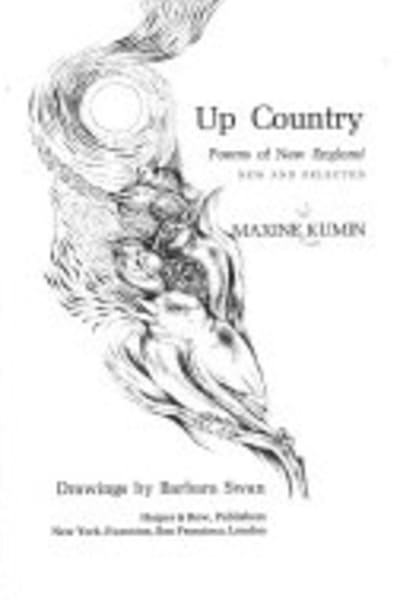
Up Country — Book Summary & Review
by Maxine Kumin
Last updated:
Up Country Summary
In Up Country, Maxine Kumin builds her poems around a recurring attention to “inner and outer realities” — how a house, a plant, a lover, or even a creature can hold thought and feeling at the same time. The book is short (about eighty-three pages), and it moves less like a narrative and more like a set of focused crossings: you’re repeatedly dropped into New England scenes where the physical details aren’t decoration but evidence. Kumin’s signature move is to treat observation as a kind of moral instrument; she’ll look at a sparrow, a garden, or the rooms of a dwelling, then let that look turn inward until the poem feels like it’s measuring your own perception.
One concrete example is the way Kumin handles the landscape as a network of presences rather than scenery. “Up Country” itself (the title poem) reads like a field report written by someone who refuses to separate tenderness from attention: the outer world keeps insisting on its reality, and the inner world answers back. Elsewhere, she leans into the idea that “houses” and “lovers” behave similarly in the mind: both are inhabited, both shape behavior, and both can become strangely uncanny when you notice them too clearly.
Kumin also has a plainspoken restraint that can feel bracing after more ornate poetry. She doesn’t chase big metaphors; she returns to close, almost tactile naming — then lets the emotional weather arrive on its own. If you want a tidy argument, Kumin doesn’t supply one; the “argument” is embodied in the poems’ method.
Honest limitation: Up Country won’t satisfy readers who want plot, character, or a conventional thematic progression. It’s also not a book that explains itself; you have to meet Kumin halfway, and if you dislike lyrical ambiguity, her poems may frustrate you.
Key Takeaways from Up Country
-
1
Inner/outer realities framework: Kumin treats external description as proof for internal life, so perception becomes the poem’s engine.
-
2
New England landscape focus: the setting functions like a cast of characters, not backdrop, shaping tone through specific local textures.
-
3
House-and-lover analogy: rooms and relationships are both “inhabited” spaces, revealing how attention changes what you think you know.
-
4
Close tactile naming: Kumin’s restraint favors concrete nouns and surfaces, letting feeling arrive without heavy-handed symbolism.
-
5
Title-poem method: “Up Country” models the book’s rhythm—field observation that turns reflective, then stays quietly unresolved.
Who Should Read This
Someone who’s been stuck in overthinking—staring at life but feeling emotionally numb—should try Up Country, because Kumin forces attention to feel physical again. If you’re craving New England poetry that treats ordinary objects as mentally alive, this short collection will likely fit your week.
Who Shouldn't Read This
If you need poems to deliver clear messages or a guided thesis, Up Country will feel evasive and too dependent on your interpretation. If you dislike lyric ambiguity or want long-form development, Kumin’s compact, image-driven approach may leave you irritated rather than moved.
Editor's Verdict
Up Country’s best trick is how Maxine Kumin makes attention itself the subject—especially in the title poem “Up Country,” where outward details keep turning into inward pressure. The real limitation is that the book offers no conventional through-line or explanatory scaffolding, so readers who want guidance may feel stranded with images. This hits hardest for anyone who’s just burned out on busy, concept-heavy reading and wants a disciplined, quiet re-tuning of the senses in a short span.
Ready to read Up Country?
Get your copy on Amazon today.
Up Country — Frequently Asked Questions
About Maxine Kumin
Maxine Kumin (1921–2014) was an American poet and writer. She grew up in New England and studied at Radcliffe College, later teaching and writing extensively about rural life and the natural world. She is credible on “Up Country” because she lived in Vermont for decades and drew on firsthand experience of small-town and countryside communities. Her other notable works include the poetry collections “Up Country” (1986) and “The Long Approach” (1988).