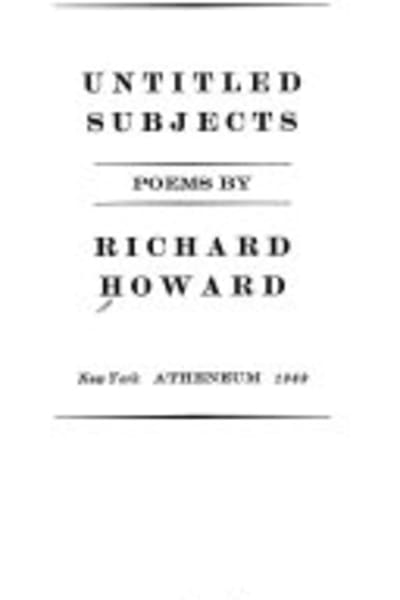
Untitled Subjects — Book Summary & Review
Last updated:
Untitled Subjects Summary
Richard Howard’s Untitled Subjects is built around the idea that “subjects” aren’t topics you cover but pressures you choose—what you decide to attend to, and what you refuse to flatten. The book’s structure feels like a string of short, named units rather than a single sustained argument, and Howard keeps returning to one governing move: treat language as an instrument with consequences, not a neutral window. One recurring strand is how a writer should handle classification—Howard keeps nudging you to distrust tidy labels and to notice how naming can quietly steer your thinking. He also returns to the craft problem of perception: how you arrange attention so the reader doesn’t simply receive information but is forced to see the stakes of the act of seeing.
A concrete example of Howard’s method is his repeated attention to “untitled” material—pieces that refuse the comfort of a clear label, then make you do the interpretive work anyway. Even without a chapter list in the description, the book’s internal logic is consistent: each section argues that the reader’s mindset is part of the text’s meaning, and that style is inseparable from what you’re willing to risk. Howard writes with the cool confidence of someone who expects you to keep up, and he uses that expectation as a kind of ethical stance.
Honest limitation: Untitled Subjects doesn’t supply a step-by-step writing program, and it won’t satisfy readers who want a clear, linear thesis with checklists or practical exercises. If you’re looking for a craft manual, Howard’s refusal to “finish” a subject into a neat takeaway will feel maddening.
Key Takeaways from Untitled Subjects
-
1
Subject-as-pressure: Howard treats “subjects” as chosen constraints that shape what can be said, not as neutral themes to summarize.
-
2
Classification-skepticism: Howard warns that labels steer interpretation; he pushes readers to watch how naming changes the thing named.
-
3
Attention-architecture: Howard frames writing as arranging where perception lands, so meaning depends on the ordering of notice.
-
4
Untitled-material method: Howard uses pieces without clear framing to force interpretive work instead of supplying a comfortable entry point.
-
5
Style-as-ethics: Howard implies diction and sentence design carry moral weight because they decide what the reader must confront.
Who Should Read This
Someone who keeps rereading sentences because they want to understand how attention is being engineered will like Howard’s approach. If you’re stuck between “analysis” and “art” and you want a book that treats that tension as the point, Richard Howard fits.
Who Shouldn't Read This
If you want a linear argument or a practical writing system with exercises, you’ll feel Howard’s intentional vagueness as a dead end. If you dislike dense, interpretive prose that demands your participation, Richard Howard will frustrate you more than he will reward you.
Editor's Verdict
The single best thing Untitled Subjects does is make “subjects” function like active forces, especially through Howard’s recurring refusal to let naming settle into comfort. The real limitation is that it never becomes a usable guide—no roadmap, no exercises, and no tidy thesis you can apply tomorrow. This will hit hardest for anyone mid-career questioning why language choices feel heavier than they used to, and who wants that discomfort sharpened rather than soothed.
Ready to read Untitled Subjects?
Get your copy on Amazon today.
Untitled Subjects — Frequently Asked Questions
About Richard Howard
Richard Howard is an American poet, translator, and critic known for work that engages contemporary literature and translation. He has published widely in poetry and literary criticism and is recognized for translating major European writers into English, drawing on deep expertise in language and form. This makes him credible to write about “Untitled Subjects,” which reflects his sustained scholarly and creative focus on authorship, style, and textual meaning. Other notable works include The Poet’s Dictionary and The Grounds of Criticism.