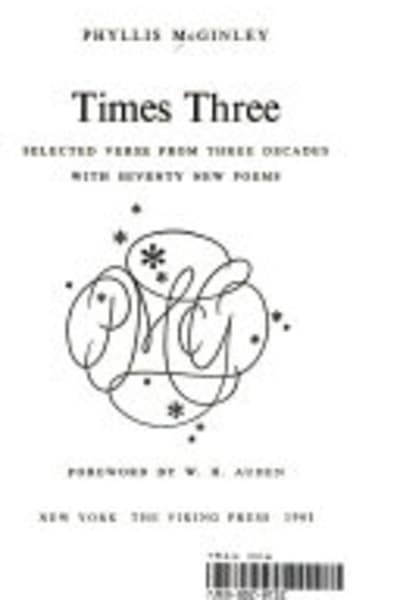
Times Three: Selected Verse From Three Decades — Book Summary & Review
Last updated:
Times Three: Selected Verse From Three Decades Summary
Times Three: Selected Verse From Three Decades is organized around Phyllis McGinley’s long arc, grouping her poems by three decades rather than by theme, which makes the book feel like a slow, deliberate audit of her own voice. McGinley’s core method is to let everyday scenes—family talk, city weather, small moral negotiations—accumulate until they start sounding like a philosophy. In the decade-based arrangement, the early poems read like someone testing how much plain speech can carry, while the later selections show her getting sharper about what she thinks matters: steadiness, civic decency, and the quiet dignity of ordinary labor.
One of the most useful things McGinley does is model a consistent tonal bargain: she won’t sermonize, but she also refuses to float in pure atmosphere. You see that in the way her lines often end with a practical turn, the kind of ending that feels like a decision rather than a flourish. The “selected verse” framing also matters—McGinley is not asking you to memorize her whole output; she’s asking you to notice the recurring moral instincts that survive stylistic shifts across years.
Here’s the honest limitation: this is not a book with explicit arguments, named chapters, or a guided study plan. If you want a thesis you can underline, or you need a clear narrative spine, you may bounce off the structure. And because it’s a selection, you’ll occasionally feel the lack of context around why a poem landed where it did.
Still, if you like poems that behave like lived experience and you want to watch McGinley’s sensibility mature across decades, this collection earns its place on your shelf.
Key Takeaways from Times Three: Selected Verse From Three Decades
-
1
Three Decades Structure: Poems are grouped by time, so you track McGinley’s voice evolving rather than chasing a single theme.
-
2
Everyday Moral Weight: Her best lines treat ordinary life as ethically charged, with endings that signal choices, not mood.
-
3
Selection Over Completeness: This book curates highlights, so you get recurring instincts without the full context of her entire career.
-
4
Plain Speech Discipline: McGinley leans on straightforward language, trusting rhythm and timing to carry meaning instead of ornament.
-
5
Tone as Ethics: Her refusal to preach is itself a stance, aiming for decency through observation and controlled irony.
Who Should Read This
Someone who keeps returning to poems that sound like real conversations—especially when life feels too busy for heavy reading—will likely get something from McGinley’s decade-spanning selections. If you’re looking for a steady, morally alert voice while you’re between projects or recalibrating your daily priorities, this book fits the mood.
Who Shouldn't Read This
If you need a collection with obvious chapter structure, named sections, or an explicit argument you can follow, you’ll find Times Three frustratingly indirect. If you only like experimental or formally radical poetry, McGinley’s classic clarity may feel too conventional to justify the price of time.
Editor's Verdict
The single best thing this book does is let McGinley’s tonal bargain—plain speech plus decisive endings—show up repeatedly across the three-decade grouping, so you can watch her sensibility sharpen over time. The real limitation is that there are no guiding chapters or thesis-driven scaffolding, so readers wanting instruction or an argument will feel stranded. Someone who’s recently burned out on “productivity” books and wants a calmer, ethically steady literary voice will hit hardest when they realize the poems are offering daily-life standards without demanding agreement.
Ready to read Times Three: Selected Verse From Three Decades?
Get your copy on Amazon today.
Times Three: Selected Verse From Three Decades — Frequently Asked Questions
About Phyllis McGinley
Phyllis McGinley (1915–1978) was an American poet and longtime contributor to The New Yorker. Raised in New York and educated at Barnard College, she became known for accessible verse and sharp observations of everyday life. Her credibility on a retrospective of her poetry comes from decades of published work and her sustained output across multiple “decades” of writing. Other notable works include The Morning After (1956) and The Well-Tempered Heart (1964).