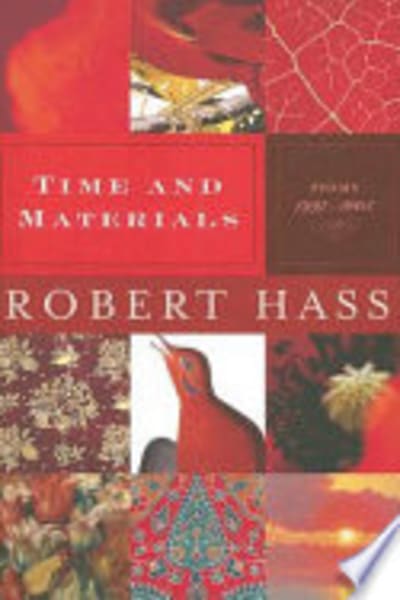
Time and Materials — Book Summary & Review
by Robert Hass
Last updated:
Time and Materials Summary
Robert Hass organizes Time and Materials around a recurring spotlight on the physical present—his poems keep returning to specific places (San Francisco, the Northern California coast, the Sierra high country) while also admitting how American life feels thick with noise, history, and private longing. The collection’s structure is less “plot” than pressure system: a poem will start in weather, paint, or a body’s ordinary motion, then widen until time—personal memory, political violence, the slow erosion of meaning—starts behaving like a character. Hass’s last name matters here because his signature method is consistent: he treats perception as an ethical act. In poems that look at art (Vermeer and Gerhard Richter are named, and the act of looking becomes a formal problem), Hass keeps asking what language can actually do once the world has already happened. He’s also attentive to the “bafflement of the present moment in American culture,” but he doesn’t solve it with slogans; he lets it sit beside desire, domestic talk, and the limits of explanation.
One concrete example is how the book handles time and memory: scenes in Berlin and the demilitarized zone between the Koreas appear not as travel postcards, but as interruptions that force the speaker to account for attention. Another is the way Hass threads domestic life and the conversation between men and women into the same frame as public history; the private argument becomes another instance of language failing or trying anyway. If you come expecting a single unified thesis, you’ll be disappointed—this is a sequence of meditations that sometimes feels like walking through rooms rather than reading one continuous argument. Time and Materials is short, but it asks you to slow down, and it will frustrate anyone who wants narrative momentum or easy emotional payoffs from Hass’s last-name-brand of clarity.
Key Takeaways from Time and Materials
-
1
Physical world immediacy: Hass writes from surfaces—weather, streets, bodies—then lets perception expose what culture hides.
-
2
Art-as-lens: Richter and Vermeer aren’t decoration; painting teaches Hass how to test language against what can’t be translated.
-
3
Violence of history: political events show up as pressure on daily speech, not as distant background facts.
-
4
Language’s limits: poems repeatedly stage failure—words can’t fix the moment, but they can still clarify attention.
-
5
Time and memory: Berlin, the Koreas, and personal recollection function like overlapping clocks with different speeds.
Who Should Read This
Someone who’s tired of poetry collections that feel like sealed-off aesthetic puzzles and wants poems that keep touching the street, the kitchen, and the news cycle. If you catch yourself rereading the same memory because it won’t settle, Hass’s time-and-attention frame will meet you there.
Who Shouldn't Read This
If you want a long, steadily unfolding argument with clear chapters and a single emotional arc, Time and Materials will feel fragmentary and restless. If you dislike poems that name-drop (Horace, Whitman, Stevens, Nietzsche, Lucretius) and make looking at art part of the work, you’ll probably bounce off Hass’s method quickly.
Editor's Verdict
The best thing Time and Materials does is make the act of attention feel like an ethical practice, especially in the poems that treat painting as a model for how language survives contact with the real. The real limitation is that it offers no single governing storyline or thesis—just a sequence of meditations that demand patience and may feel diffuse. This hits hardest for anyone returning to poetry after a stretch of productivity-logic thinking and needing to relearn how to be present without “fixing” everything.
Ready to read Time and Materials?
Get your copy on Amazon today.
Time and Materials — Frequently Asked Questions
About Robert Hass
Robert Hass (born 1941) is an American poet and essayist, educated at the University of California, Berkeley, and Stanford University. He has published widely in poetry and criticism and is known for writing about attention, language, and nature. He is credible to write on these themes through his long career as a practicing poet and editor, including serving as U.S. Poet Laureate (1995–1997). Notable works include Time and Materials and The Essential Rumi.