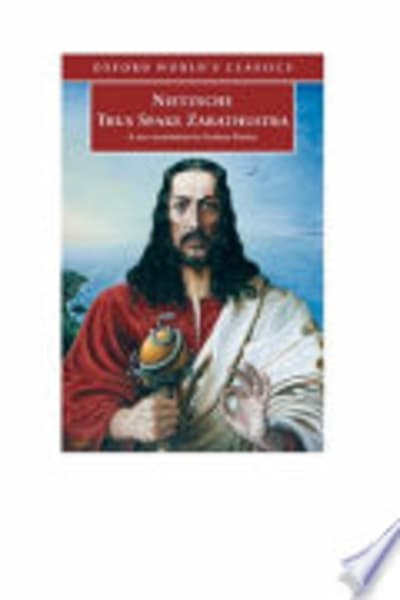
Thus Spoke Zarathustra — Book Summary & Review
Last updated:
Thus Spoke Zarathustra Summary
Nietzsche's Thus Spoke Zarathustra kicks off with the protagonist's retreat to the mountains, setting the stage for his exploration of the Ubermensch concept. The structure is as much a poetic narrative as it is a philosophical inquiry, with sections like 'The Three Metamorphoses' illustrating Zarathustra's journey toward transcendence. Nietzsche uses Zarathustra to challenge conventional morality, introducing notions like 'The Eternal Recurrence' to question the nature of existence itself. However, the book's abstract style and allegorical content may alienate readers seeking straightforward philosophical arguments. Nietzsche's prose, rich with symbolism and metaphor, can be both an enlightening and a perplexing experience, depending on the reader's patience for such depth.
Key Takeaways from Thus Spoke Zarathustra
-
1
Ubermensch: Nietzsche's ideal individual who transcends traditional morality and creates their own values.
-
2
The Eternal Recurrence: A thought experiment Nietzsche uses to ponder the infinite repetition of life's events.
-
3
The Three Metamorphoses: Zarathustra's allegory of spiritual transformation involving a camel, lion, and child.
-
4
Will to Power: A central concept positing that the primary drive in humans is to assert and enhance their power.
-
5
The Death of God: Nietzsche's assertion that traditional religious beliefs are becoming obsolete in modern society.
Who Should Read This
If you find yourself questioning the moral frameworks imposed by society, Nietzsche's radical ideas might offer a thrilling perspective. Someone who thrives on philosophical challenges and enigmatic prose will find much to ponder here.
Who Shouldn't Read This
If you prefer clear-cut philosophical arguments without allegorical detours, this book will frustrate you. Those looking for a straightforward philosophical treatise with immediate practical applications may want to steer clear.
Editor's Verdict
The book's strength lies in 'The Three Metamorphoses', where Nietzsche vividly illustrates the stages of personal transformation. Its abstract nature can be a barrier for those seeking direct, actionable insights. For anyone experiencing a crisis of faith or questioning societal norms, this book resonates deeply.
Ready to read Thus Spoke Zarathustra?
Get your copy on Amazon today.
Thus Spoke Zarathustra — Frequently Asked Questions
About Friedrich Nietzsche
Friedrich Nietzsche (1844-1900) was a German philosopher and philologist known for his profound impact on modern thought. Educated at the University of Bonn and Leipzig, he became a professor at the University of Basel at 24. Nietzsche's work, "Thus Spoke Zarathustra," explores themes of existentialism and the Übermensch. His credibility stems from his extensive philosophical background. Other notable works include "Beyond Good and Evil" and "The Birth of Tragedy."