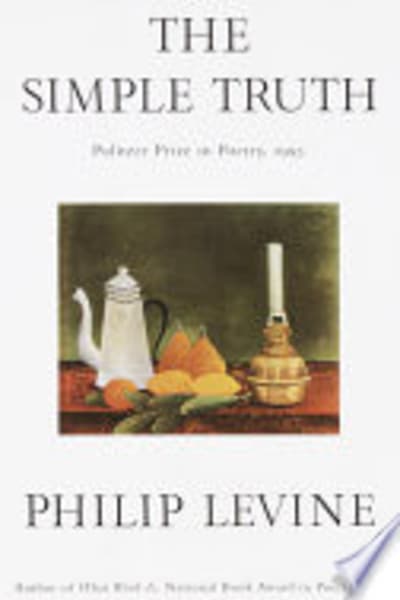
The Simple Truth — Book Summary & Review
Last updated:
The Simple Truth Summary
In The Simple Truth, Philip Levine organizes the collection as thirty-three poems that keep returning to the same pressure points: myth, family memory, and public history, braided through what Levine treats as “truth” rather than tidy meaning. You can feel his method early—he’ll set a scene from ordinary life, then let it acquire a second layer of history, as if the past is always leaning over your shoulder. One of the clearest examples is “What Work Is,” where the poem’s plainspoken attention to labor turns into a moral weather system: the work itself becomes a record of who gets seen and who gets erased. Across the book, Levine keeps insisting that invention isn’t escape; it’s a way to tell the truth when literal narration can’t carry the weight.
Levine’s myth-historical threads aren’t decorative. They reappear like family traits—names, silences, inherited gestures—so the “complex web” in the description feels earned rather than ornamental. In poem after poem, Levine uses specificity to argue that memory is not a museum; it’s a tool that can sharpen perception or dull it, depending on how you handle it. When he shifts from the private to the public, he doesn’t smooth the transition; he makes you notice the seam.
A limitation: this is not a book that explains itself. If you want a guided thesis, a consistent narrative arc, or poems that land with clean closure, Levine may frustrate you, because the collection’s “truth” is insistently plural and sometimes stubbornly unresolved. Also, at ~69 pages, you don’t get the sustained development you’d expect from a longer work—some poems feel like detonations rather than arguments, and you’ll either love that compression or wish for more space.
Key Takeaways from The Simple Truth
-
1
Myth-and-memory weaving: Levine treats myth as a family organ, so private recollection and public history keep syncing.
-
2
Truth as “plural”: “truth” in Levine is not one statement; it’s a changing set of perceptions you revise with each poem.
-
3
Labor as moral record: In poems like “What Work Is,” work becomes evidence of dignity, exploitation, and social visibility.
-
4
Seam between private and public: Levine refuses smooth transitions, forcing you to notice how history presses into everyday life.
-
5
Compression over explanation: At ~69 pages, Levine gives flashes more than frameworks, so you must tolerate ambiguity.
Who Should Read This
Someone who keeps rereading the same old family stories and noticing how they smuggle in larger history will probably latch onto Levine’s approach. If you’re in a season of burnout where you want language that respects mess and contradiction, The Simple Truth will feel like relief.
Who Shouldn't Read This
If you need poems to deliver a clear thesis, clean narrative progression, or explanatory commentary, Levine’s refusal to resolve will feel like a wall. If you dislike mythic or historical allusion and want mostly contemporary realism, this collection will read like work you didn’t sign up for.
Editor's Verdict
The single best thing Philip Levine does here is make labor-and-memory inseparable, with “What Work Is” functioning as a kind of emotional logic for the rest of the book. The real limitation is that Levine offers almost no handrails: you’re dropped into symbolic seams and expected to live with ambiguity. This hits hardest for anyone who’s just lost patience with self-help clarity and wants language that argues through images while refusing to tie everything up.
Ready to read The Simple Truth?
Get your copy on Amazon today.
The Simple Truth — Frequently Asked Questions
About Philip Levine
Philip Levine (1928–2015) was an American poet and educator known for writing about working-class life. Born in Detroit, he grew up in a blue-collar environment and worked in the auto industry before teaching. His experience with labor and industrial communities, along with decades of literary scholarship and publication, makes him credible on the themes in The Simple Truth. Other notable works include The Names and The Mercy.