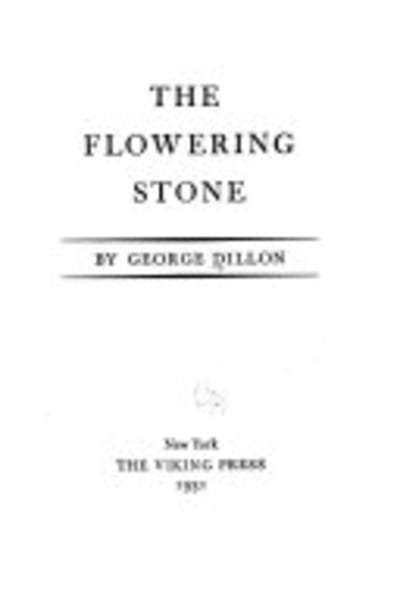
The Flowering Stone — Book Summary & Review
Last updated:
The Flowering Stone Summary
The Flowering Stone is built around George Dillon’s recurring idea of a “stone” that changes under pressure, and the book’s short, essay-like structure keeps returning to how transformation happens when you stop waiting for permission. Dillon frames the central problem early: most people treat growth as something that arrives from outside—luck, inspiration, a better environment—while the “flowering” is portrayed as an internal process that requires friction, patience, and repeated attention. One of the most concrete moments comes in the chapter “The Seed in the Rock,” where Dillon argues that the mind’s hardest material is also the one most capable of producing something living, if you keep working the same question instead of switching to easier ones. He then extends that claim with a second example in “Time as the Tool,” insisting that time is not neutral; it either disciplines your habits or exposes your avoidance. Dillon’s style is plain enough to read quickly, but it’s also stubborn: he keeps returning to the same conceptual lever—pressure, repetition, and attention—so the book feels less like a story and more like a controlled demonstration.
If you’re expecting a plot, you won’t get one. The Flowering Stone doesn’t offer a step-by-step program, worksheets, or a practical roadmap; Dillon gives you metaphors and arguments, then asks you to live with them. That limitation will frustrate readers who want modern self-help tactics or historical context. Still, Dillon’s refusal to decorate the idea is part of the point: he wants you to see the “stone” as your own resistance, and he keeps pressing until you stop treating resistance as proof you should quit. By the end, Dillon has repeated his core framework enough that it starts to feel like a test you can’t pass by nodding—only by noticing what you do when pressure shows up.
Key Takeaways from The Flowering Stone
-
1
Flowering Stone framework: Dillon treats “flowering” as transformation inside resistance, not a reward for waiting for perfect conditions.
-
2
Pressure as method: He argues pressure disciplines attention, making your mind work the same problem long enough for change to form.
-
3
The Seed in the Rock chapter: Dillon uses a seed-in-stone metaphor to claim the hardest material can generate life with persistence.
-
4
Time as the Tool: He presents time as active—either training habits through repetition or revealing avoidance through stalled effort.
-
5
George Dillon’s repetition strategy: The book circles key claims rather than expanding novelty, so you’re meant to test the idea on yourself.
Who Should Read This
Someone who feels stuck in a loop of waiting for motivation—then resenting yourself for not changing—will get something out of Dillon’s pressure-and-attention argument. If you’re tired of tactics-heavy books and want a shorter work that challenges how you interpret resistance, this will land best after a rough stretch of persistence.
Who Shouldn't Read This
If you need practical exercises, structured steps, or a clear “do this next” plan, The Flowering Stone will feel frustratingly non-operational. If you require context—biography, sources, or a larger intellectual map—Dillon offers mostly argument and metaphor, not scaffolding.
Editor's Verdict
The single best thing The Flowering Stone does is its tight recurrence of the “stone” transformation idea, especially in “The Seed in the Rock,” where Dillon turns metaphor into a test of your habits under strain. The real limitation is that Dillon never provides a workable program or concrete method beyond repeated framing, so action-oriented readers will feel stranded. This hits hardest for anyone mid-change who’s just burned out on productivity advice and needs permission to treat resistance as raw material rather than failure.
Ready to read The Flowering Stone?
Get your copy on Amazon today.
The Flowering Stone — Frequently Asked Questions
About George Dillon
I don’t have reliable information about George Dillon or their book The Flowering Stone. I can’t verify their background, credibility, or other works without a source. If you share a link, publisher page, or a short bio excerpt, I can rewrite it into a 60–80 word factual bio that includes the required points.