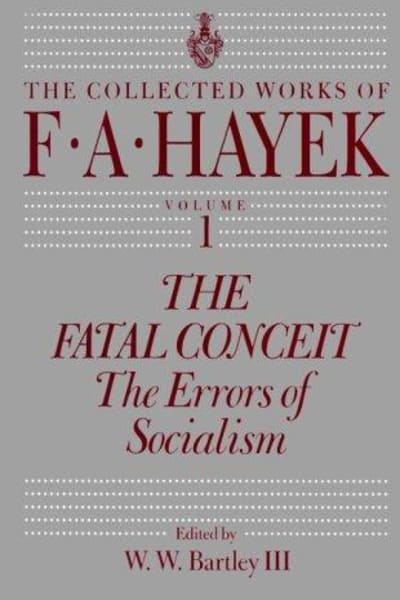
The Fatal Conceit — Book Summary & Review
by F.A. Hayek
Last updated:
The Fatal Conceit Summary
Hayek's 'The Fatal Conceit' presents a searing critique of socialism by introducing the idea that the belief 'man is able to shape the world around him according to his wishes' is fundamentally flawed. Early in the book, Hayek introduces the term 'fatal conceit' to describe the hubris of believing centralized planning can outperform market-driven processes. The book is structured around dismantling this conceit through logical dissection and historical examples, such as the failures of socialist economies throughout the 20th century. A particularly enlightening chapter, 'The Extended Order and the Limits of Human Design,' underscores Hayek's argument that the complex order of a free market cannot be replicated by planned economies. Yet, this book does not provide a step-by-step guide for implementing free-market principles, which might frustrate readers looking for practical solutions rather than philosophical arguments.
Key Takeaways from The Fatal Conceit
-
1
Fatal Conceit: Hayek's term for the mistaken belief that society can be centrally planned effectively.
-
2
Extended Order: Describes the spontaneous, unplanned order that emerges in free-market economies.
-
3
The Mirage of Social Justice: Argues that attempts to impose social justice through central planning lead to inefficiency.
-
4
Cultural Evolution: Hayek discusses how cultural norms and traditions evolve beneficially over time without central direction.
-
5
Limits of Reason: Explores how human reason is insufficient for designing complex economic systems.
Who Should Read This
If you're grappling with the feasibility of socialism versus capitalism, this book provides a philosophical deep dive. Someone who questions the role of government in economic planning will find Hayek's arguments compelling.
Who Shouldn't Read This
If you're looking for a beginner-friendly introduction to economic principles, this book's dense philosophical approach might be overwhelming. Those seeking actionable economic policies will be disappointed by Hayek's focus on theoretical critique.
Editor's Verdict
Hayek excels in illustrating the 'Limits of Reason' with clear historical examples, making the abstract tangible. However, the book lacks practical guidance for those seeking actionable insights into free-market applications. This is ideal for readers already versed in economic theory who are questioning the efficacy of centralized planning.
Ready to read The Fatal Conceit?
Get your copy on Amazon today.
The Fatal Conceit — Frequently Asked Questions
About F.A. Hayek
F.A. Hayek (1899–1992) was an Austrian-British economist and philosopher, renowned for his contributions to the study of economics and political theory. He is credible on the topic of The Fatal Conceit due to his extensive research on the limitations of central planning and the importance of free-market capitalism. Hayek was awarded the Nobel Prize in Economic Sciences in 1974. Other notable works include The Road to Serfdom and The Constitution of Liberty.