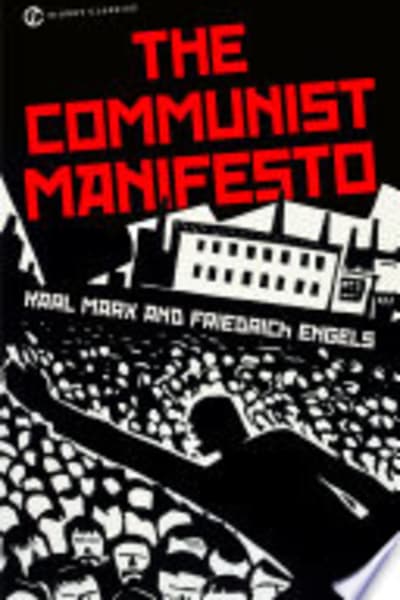
The Communist Manifesto — Book Summary & Review
by Karl Marx
Last updated:
The Communist Manifesto Summary
Marx’s “Communist Manifesto” is built around a stark ladder of claims: class struggle moves history, capitalism concentrates wealth, and the proletariat must organize to replace the existing political order. In the opening sections, Marx and Engels lay out the “history of all hitherto existing society” as a sequence of class antagonisms, then sharpen the point through the bourgeoisie’s role in constantly revolutionizing production. The argument isn’t subtle: capitalism creates its own gravediggers by expanding the proletariat, while also stripping workers of control over their labor. Marx then turns to the “Communist” position as a political program, insisting the communists aren’t a separate sect so much as the most consistent expression of working-class interests. The famous “Ten Points” (including progressive taxation and centralization of credit) are presented less as a utopian checklist than as emergency policy moves designed to dismantle capitalist power structures.
One of the most memorable concrete examples is their claim about how the bourgeoisie destroys older social forms—guilds, patriarchal ties, and local markets—by pulling everything into global commerce. Marx also uses the language of “primitive accumulation” in spirit, describing how wealth and property relations are built through coercion and dispossession, not through some neutral market process. If you’ve ever watched a workplace become more automated while your bargaining position shrinks, Marx’s diagnosis lands with a mean kind of accuracy.
A limitation: the Manifesto doesn’t do what readers often want from a philosophy text—it doesn’t deeply prove every historical claim or provide a careful, data-driven account of how capitalism will unfold step by step. It’s polemical, compressed, and sometimes historically sweeping in ways that will frustrate anyone looking for rigorous social-science method rather than an ideological forecast.
Key Takeaways from The Communist Manifesto
-
1
Class struggle: Marx frames history as conflict between social classes, not as a steady march of ideas or leaders.
-
2
Bourgeoisie revolutionizes production: capitalism expands markets and technology while destabilizing older jobs and communities.
-
3
Proletariat as gravedigger: Marx argues workers’ growing numbers and misery make them the force capable of overturning capitalism.
-
4
Communists’ relation to proletarians: Marx insists communists represent the most consistent wing of working-class politics, not a separate moral club.
-
5
Ten Points program: the listed policies target property, credit, and inheritance to weaken capitalist power and reorganize society.
Who Should Read This
If you’re trying to make sense of why work feels more precarious even when productivity rises, this gives you a ready-made framework for interpreting that pattern. Someone who’s frustrated by vague “systemic” talk and wants a concrete, if ruthless, theory of class conflict will likely stick with it.
Who Shouldn't Read This
If you want slow, evidence-heavy argumentation with modern economic data, the Manifesto’s compressed polemic will feel lazy and overconfident. If you prefer philosophy that focuses on ethics or individual meaning rather than political economy and collective struggle, Marx will frustrate you.
Editor's Verdict
The best thing Marx does here is connect capitalism’s internal logic to class formation, especially through the Manifesto’s “bourgeoisie” section describing how it reshapes society by revolutionizing production. The real limitation is that it offers a political forecast and program without the careful empirical or historical proof many readers expect. This hits hardest for anyone who’s just been laid off or had their role downgraded while the company keeps “innovating,” because Marx supplies a narrative for that mismatch.
Ready to read The Communist Manifesto?
Get your copy on Amazon today.
The Communist Manifesto — Frequently Asked Questions
About Karl Marx
Karl Marx (1818–1883) was a German philosopher, economist, and political theorist. He studied law and philosophy at the University of Bonn and the University of Berlin, later writing extensively on capitalism and political economy. Marx is credible on the topic of communism because he analyzed industrial capitalism’s economic dynamics and co-authored major revolutionary political writing. He co-wrote The Communist Manifesto (1848) with Friedrich Engels and authored Das Kapital (volumes published 1867–1894).