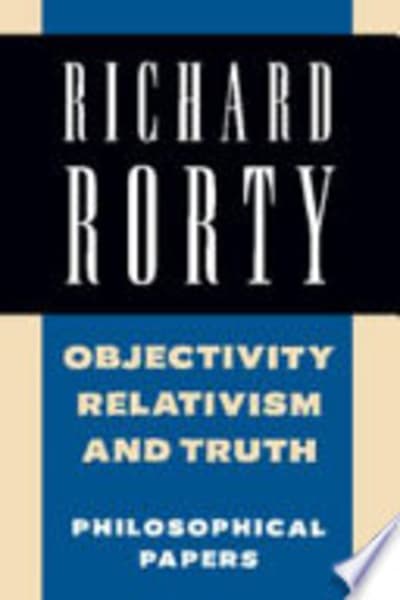
Objectivity, Relativism, and Truth — Book Summary & Review
Last updated:
Objectivity, Relativism, and Truth Summary
Rorty introduces the concept of 'intersubjectivity' in 'Objectivity, Relativism, and Truth', which redefines objectivity as a community-driven pursuit rather than a quest for universal truths. The book is structured around essays that explore the implications of this notion for various philosophical discussions, notably in how scientific inquiry is framed. In the chapter 'The Priority of Democracy to Philosophy', Rorty argues for a pragmatic approach where philosophical debates serve democratic ends, rather than abstract ideals. He is particularly interested in the moral virtues of scientific communities, suggesting that these virtues provide a more practical framework for inquiry than traditional scientific methods. However, readers might find the book frustrating if they are looking for a straightforward philosophical system or clear-cut conclusions, as Rorty's work thrives on ambiguity and debate rather than definitive answers.
Key Takeaways from Objectivity, Relativism, and Truth
-
1
Intersubjectivity: Rorty describes objectivity as a consensus-driven process, focusing on utility rather than universal truth.
-
2
Moral Virtues of Science: Emphasizes the ethical commitments of scientific communities over rigid methodologies.
-
3
Pragmatic Philosophy: Philosophy should serve democratic purposes, not aim for abstract, ultimate truths.
-
4
Cultural Politics: Argues that philosophy is a form of cultural politics, shaping societal values and norms.
-
5
Anti-Essentialism: Rejects the idea of inherent truths, advocating for context-dependent understanding.
Who Should Read This
If you find yourself wrestling with the rigid boundaries of traditional philosophy, this book offers a fresh perspective. Someone who questions the absolutes and seeks philosophical flexibility will appreciate Rorty's approach.
Who Shouldn't Read This
If you crave a linear narrative or definitive philosophical system, this book will likely frustrate you. Rorty's style is dense and assumes a familiarity with philosophical debates, making it unsuitable for beginners.
Editor's Verdict
The book's most intriguing element is its redefinition of objectivity in terms of intersubjectivity, which is both challenging and refreshing. However, readers looking for a more structured argumentation will be disappointed by its essay format and open-ended conclusions. Ideal for someone currently grappling with philosophical rigidity or entrenched in debates about the nature of truth.
Ready to read Objectivity, Relativism, and Truth?
Get your copy on Amazon today.
Objectivity, Relativism, and Truth — Frequently Asked Questions
About Richard Rorty
Richard Rorty (1931-2007) was an American philosopher known for his contributions to pragmatism and his critique of traditional epistemology. He earned his Ph.D. from Yale University and taught at Princeton, the University of Virginia, and Stanford. Rorty's credibility on topics like objectivity and truth stems from his extensive work in philosophy, particularly his influential book "Philosophy and the Mirror of Nature." Other notable works include "Contingency, Irony, and Solidarity" and "Achieving Our Country."