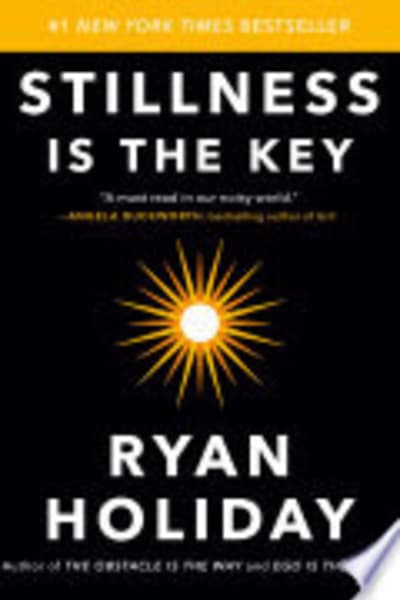
Stillness Is the Key — Book Summary & Review
by Ryan Holiday
Last updated:
Stillness Is the Key Summary
Stillness Is the Key is built around Ryan Holiday’s core claim that stillness isn’t “doing nothing,” but a disciplined mental posture—what he treats as a lever for self-mastery, especially when your temper, ego, or attention is being yanked around. The book’s structure is basically a sequence of arguments followed by historical proof: Holiday lays down a principle, then returns to it through examples ranging from Marcus Aurelius’s control of impressions to Thich Nhat Hanh’s attention to the present moment. One of the most useful recurring moves is how Holiday frames distraction as a choice of what you feed your mind; he keeps steering you back to the same practice: slow down internally so you can respond instead of react.
A concrete example: Holiday’s discussion of “the doorway” quality of stillness—his insistence that quiet is what makes better judgment possible—lands hardest when he contrasts frantic public life with deliberate private routine. His Churchill material, including the image of bricklaying and painting at Chartwell, functions like a template for how to keep an inner governor even while you’re outwardly busy. Another example that stuck with me is his use of Fred Rogers: Holiday doesn’t treat Rogers as a saint floating above the world; he treats him as someone who practiced attention to what others miss, which is stillness turned outward.
Where Holiday’s argument can feel repetitive is the way he circles the same emotional problem (reactivity) with many names and eras. He also doesn’t offer a lot of step-by-step troubleshooting for people with anxiety or ADHD who need specific behavioral interventions, not just philosophical framing. If you want a psychology study or a program with measurable exercises, you’ll likely feel under-served.
Key Takeaways from Stillness Is the Key
-
1
Stillness as self-mastery: Holiday defines stillness as trained responsiveness—pause first, then choose your action instead of obeying impulses.
-
2
Distraction as attention management: He treats distraction as a mental habit you can starve by refusing constant input and returning to one internal anchor.
-
3
Stoic control of impressions: Holiday uses Marcus Aurelius-style thinking to separate what happens from what you allow to become your reaction.
-
4
Zen practice through example: He points to Sadaharu Oh’s Zen study as evidence that calm focus can produce elite performance under pressure.
-
5
Inner routine over public frenzy: Holiday’s Churchill/Chartwell contrast argues that private quiet safeguards ethical judgment when the world demands speed.
Who Should Read This
Someone who keeps snapping, spiraling, or doom-scrolling after a stressful day will find Holiday’s stillness framework immediately relevant. If you’re stuck in the “work harder, think faster” loop and want a way to regain control of your attention, Holiday gives you a language for it.
Who Shouldn't Read This
If you want a research-heavy book with rigorous studies, Holiday’s mostly historical and anecdotal method will feel light and occasionally repetitive. If you need concrete clinical tools for anxiety or attention disorders, Stillness Is the Key won’t give you the behavioral protocols you’re expecting.
Editor's Verdict
The best thing about Stillness Is the Key is how Ryan Holiday repeatedly converts abstract calm into actionable self-control, especially through his stillness-as-doorway argument and the Churchill-at-Chartwell example. The limitation is that Holiday leans on moral-philosophical storytelling more than he provides practical troubleshooting for modern mental-health realities. This will hit hardest for anyone mid-career who’s burned out on productivity chatter and realizes their real problem is reactivity, not effort.
Ready to read Stillness Is the Key?
Get your copy on Amazon today.
Stillness Is the Key — Frequently Asked Questions
About Ryan Holiday
Ryan Holiday is an American author and former marketer who writes about philosophy, self-discipline, and Stoicism. He has studied and popularized ancient thinkers such as Marcus Aurelius and Epictetus, translating their ideas into modern guidance on calm, focus, and resilience. His credibility comes from years of researching primary Stoic texts and building a body of work applying them to everyday life. Notable books include The Obstacle Is the Way and Ego Is the Enemy.