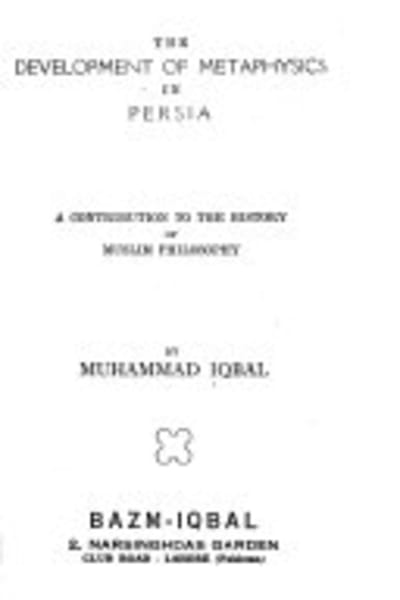
The Development of Metaphysics in Persia — Book Summary & Review
Last updated:
The Development of Metaphysics in Persia Summary
Iqbal’s The Development of Metaphysics in Persia is organized around a historical-philosophical storyline that tracks how Persian thinkers reshaped inherited metaphysical questions, especially through Islamic philosophical frameworks and Persian adaptations. Early on, Iqbal keeps returning to a contrast he treats as structural: metaphysics in Persia is not a museum of doctrines but a series of problems—about being, causality, and the knowability of the Real—that different authors answer with different metaphysical “temperaments.” One concrete example is his attention to Avicennian influence and how later Persian writers either intensify or resist that inheritance when they confront the status of universals and the relation between essence and existence. Iqbal then pivots from doctrine to development, arguing that Persian metaphysics evolves by reworking tools (logical distinctions, metaphysical hierarchies) into new patterns of spiritual and philosophical urgency.
A second example comes in the way Iqbal treats the later tradition’s engagement with divine transcendence and human access to reality. He frames this as a tension that drives reformulations: metaphysics must speak about God without collapsing God into a mere object of thought, and it must still explain how human experience can have genuine cognitive purchase. Even when his prose stays tightly academic, the book’s argument is clear: the “development” he describes is selective—Iqbal highlights lines of influence, but he also implies that Persian metaphysics changes because Persian thinkers keep re-asking the same metaphysical questions under different constraints. The limitation is real: this book is not a guided tour of Persian philosophy’s social history, and it will frustrate readers who want a broad, balanced survey with lots of names and dates rather than Iqbal’s chosen interpretive through-line. If you’re expecting a full reference work, Iqbal will feel like a curator with strong opinions and a narrow exhibition.
Key Takeaways from The Development of Metaphysics in Persia
-
1
Metaphysical development: Iqbal treats Persian metaphysics as problem-solving history, not a catalog of doctrines or schools.
-
2
Essence-existence focus: He uses the distinction to show how later Persian thinkers revise what “real” means beyond logic.
-
3
Avicennian inheritance: Iqbal traces how Avicenna’s framework gets adapted or resisted when Persian writers confront access to the Real.
-
4
Divine transcendence tension: He argues Persian metaphysics keeps rewriting God-talk so it doesn’t turn God into an ordinary object.
-
5
Interpretive through-line: Iqbal selects influences to support one narrative, so some traditions feel underrepresented.
Who Should Read This
Someone who is stuck in the “doctrine list” phase of studying philosophy—reading summaries but not seeing how questions evolve—will get traction from Iqbal’s development-focused approach. If you’re preparing for an academic paper or seminar on Islamic or Persian metaphysics and want a tight interpretive map rather than a broad encyclopedia, Iqbal is worth your time.
Who Shouldn't Read This
If you want a comprehensive, name-heavy overview of Persian philosophy across centuries, Iqbal’s selective focus will feel like missing pieces. If you dislike dense, argument-driven historical philosophy and prefer modern, jargon-light explanations, Iqbal’s early-20th-century style will likely irritate you.
Editor's Verdict
The single best thing The Development of Metaphysics in Persia does is show how Iqbal links metaphysical concepts to a lived philosophical tension—especially his recurring work on divine transcendence and human cognitive access—so the history feels argumentative rather than decorative. The real limitation is that Iqbal offers an interpretive narrative with gaps, not a comprehensive reference survey of Persian philosophy. This will hit hardest for graduate students and serious self-studiers who are rewriting their literature review midstream and need a coherent through-line from Iqbal to structure their own reading.
Ready to read The Development of Metaphysics in Persia?
Get your copy on Amazon today.
The Development of Metaphysics in Persia — Frequently Asked Questions
About Sir Muhammad Iqbal
Sir Muhammad Iqbal (1877–1938) was a philosopher, poet, and jurist from British India, born in Sialkot and educated in Lahore, Cambridge, and Munich. He became a leading scholar of Islamic and Persianate thought, with expertise in metaphysics and intellectual history. His credibility on Persian metaphysics is grounded in his academic training and his sustained analysis of Muslim philosophical traditions. Other notable works include The Reconstruction of Religious Thought in Islam and Asrar-e-Khudi (The Secrets of the Self).