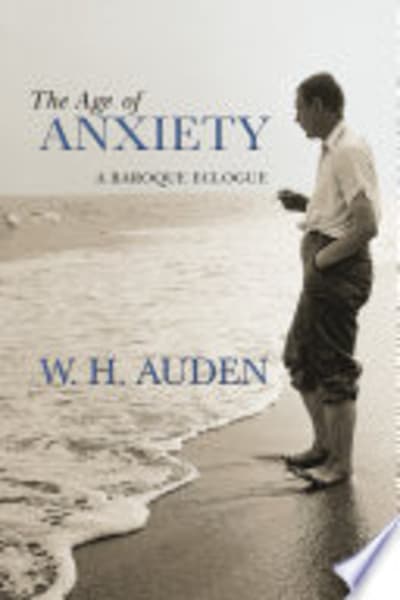
The Age of Anxiety — Book Summary & Review
by W. H. Auden
Last updated:
The Age of Anxiety Summary
In The Age of Anxiety, W. H. Auden organizes the book around a public, almost civic mood: anxiety is treated less as a private feeling and more as the weather system of modern civilization. Auden’s signature move is to stage that anxiety through set pieces—especially the long poem “September 1, 1939,” which doesn’t simply mourn the start of World War II but tries to diagnose how ordinary people get pulled into catastrophe. Auden’s framework keeps returning to the same uncomfortable idea: when mass life loses shared moral language, individuals substitute performance, slogans, and self-justification for responsibility. He writes with a sharp ear for rhythm and a cool, educated voice, but the emotional temperature stays cold enough to feel intentional rather than detached.
Auden also makes the book feel structured, not random. You can feel the sequence of poems nudging you from observation to accusation to a kind of grim, disciplined hope. In “Musée des Beaux Arts,” for instance, he uses the plain facts of a painting’s world—people continuing their routines while catastrophe happens off to the side—to argue that suffering often arrives with no special spotlight. That’s the book’s method: he shows the mechanics of moral blindness, then forces you to notice your own comfort with it. Even when Auden sounds like he’s lecturing, he’s really tightening a net: he wants you to see anxiety as a symptom of collective failure, not as a fashionable inner drama.
Honest limitation: if you’re looking for a straightforward self-help plan or a single, tidy thesis you can apply to your daily life, Auden won’t give it. The Age of Anxiety is poetry—dense, allusive, and sometimes relentlessly unsympathetic to easy catharsis. You may finish it feeling smarter and a little less soothed, which is not the same thing as comfort.
Key Takeaways from The Age of Anxiety
-
1
September 1, 1939 frames anxiety as a civic condition, showing how public events expose the moral emptiness of routine thinking.
-
2
Musée des Beaux Arts treats suffering as offstage reality, arguing that everyday life often continues without moral recognition.
-
3
Auden’s moral accounting approach turns private emotion into evidence, so fear becomes a clue about social responsibility.
-
4
Modern civilization imagery in the poems links institutions to inner corrosion, suggesting anxiety spreads through systems and language.
-
5
Auden’s disciplined tone refuses consolation, pushing readers to sit with discomfort instead of converting it into comfort.
Who Should Read This
Someone who feels anxious but can’t quite name what’s wrong—because work, news, and relationships keep blurring together—will likely recognize their own mental weather in Auden’s public diagnosis. If you’ve been stuck in doom-scrolling and vague dread, Auden’s insistence on moral mechanics can give that dread a sharper target.
Who Shouldn't Read This
If you want lyrical escape or emotional warmth on demand, Auden’s controlled, sometimes prosecutorial voice will feel more like being examined than being soothed. If you need a practical takeaway list, The Age of Anxiety will frustrate you because it offers diagnosis and pressure, not a program.
Editor's Verdict
The single best thing The Age of Anxiety does is use “September 1, 1939” to treat anxiety as a collective moral failure rather than a private mood, and Auden sustains that logic across the collection. The real limitation is that it refuses comfort and often asks you to work for meaning through density, irony, and historical allusion. This hits hardest for anyone in the middle of a life transition—especially when you’re questioning whether your values are real or just habits wearing a friendly face.
Ready to read The Age of Anxiety?
Get your copy on Amazon today.
The Age of Anxiety — Frequently Asked Questions
About W. H. Auden
W. H. Auden (1907–1973) was an English poet and critic associated with modernist literature. Born in York and educated at Oxford, he wrote extensively on politics, society, and culture in the interwar and postwar periods. He is credible on “The Age of Anxiety” because the poem (1936) directly addresses the psychological and social pressures of the 1930s. Other notable works include “The Shield of Achilles” (1955) and “The Orators” (1932).