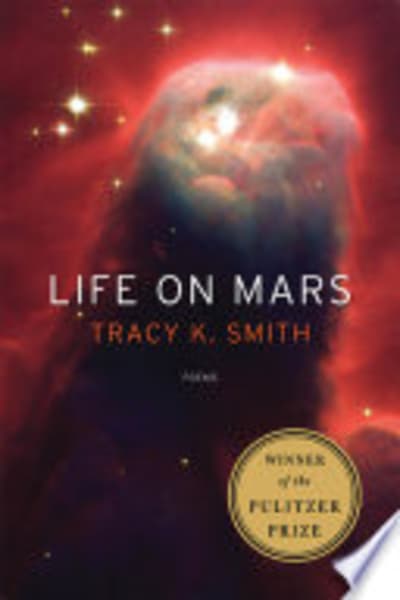
Life on Mars — Book Summary & Review
Last updated:
Life on Mars Summary
In Life on Mars, Tracy K. Smith builds the book as a set of imagined transmissions—poems that behave like a universe’s soundtrack—so the emotional argument arrives through sound, not through plot. Smith’s controlling framework is the sci-fi lens used to test what we think is fixed: love, illness, even God. She stages this in “No Fly Zone,” where a parent’s helpless waiting (“kicking like a baby”) turns into a brutal question of what a life would say if it could talk, and the poem’s interplanetary posture keeps collapsing back onto an actual crib, an actual room, an actual body. She also keeps returning to the father-daughter orbit that defines her book’s stakes: the daughter held “in the basement” by her own father, and Smith’s own grief over her father, an engineer tied to the Hubble Space Telescope. That’s not decorative biography; Smith uses it like a tuning fork, so every cosmic reference rings with domestic pressure.
What makes Life on Mars feel finished rather than merely clever is how Smith threads public mythology through private damage. In poem after poem, celebrities and pop stars walk through the world like background radiation, while “dark matter” becomes a metaphor for closeness and distance that you can feel in family life, not just in astrophysics. Even her “Museum of Obsolescence” concept—kitsch ideas pushed into a display case—doesn’t let you off the hook; it asks whether we’re curating feelings instead of living them. Smith’s limitation is scope: at ~75 pages, the book can’t fully develop its sci-fi worldbuilding, so readers expecting a sustained narrative arc or a clear political program may feel teased rather than satisfied. Still, if you want poetry that uses cosmic imagery to sharpen grief, power, and inheritance, Smith’s choices land with rare precision.
Key Takeaways from Life on Mars
-
1
No Fly Zone: A prayer-shaped scene where waiting for God collapses into a baby-crib reality and exposes parental helplessness.
-
2
Museum of Obsolescence: Smith treats love and illness as outdated exhibits, then forces you to ask who benefits from that distance.
-
3
Dark matter: The book uses a physics term as an emotional map for closeness, separation, and the invisible forces between people.
-
4
Hubble Space Telescope memory: Smith’s father-engineer history turns cosmic technology into a grief engine that keeps returning to the body.
-
5
Interplanetary soundtrack: The “universe” framing makes meaning arrive through rhythm and image, not through explanation or plot.
Who Should Read This
Someone who’s grieving a parent or nursing complicated anger in a family relationship will feel Smith’s father-daughter gravity immediately. If you like poems that treat sci-fi imagery as a pressure test for everyday life, you’ll likely leave the book with sharper feelings than when you started.
Who Shouldn't Read This
If you need a linear story, clear character arcs, or sustained worldbuilding, Life on Mars will frustrate you because it moves by associative jumps. If you dislike poetry that mixes politics, metaphysics, and domestic horror without offering a tidy takeaway, Smith’s tonal shifts may feel like too much.
Editor's Verdict
The single best thing Life on Mars does is fuse cosmic metaphor with specific family scenes, especially through “No Fly Zone,” where waiting and faith become physical panic. The real limitation is that the book’s sci-fi framing never becomes a fully developed narrative world, so readers wanting sustained plot payoff may feel underfed. This hits hardest for anyone who’s recently lost a parent or is stuck re-litigating what that loss means, because Smith keeps dragging the universe back to the room where love goes wrong.
Ready to read Life on Mars?
Get your copy on Amazon today.
Life on Mars — Frequently Asked Questions
About Tracy K. Smith
Tracy K. Smith is an American poet and professor. She earned an MFA from Columbia University and has taught at institutions including Princeton University. Smith’s credibility on space and science-inflected themes comes from her published poetry and her long-running engagement with astronomy and the broader scientific imagination. Her collections include Life on Mars (2011) and Wade in the Water (2018).