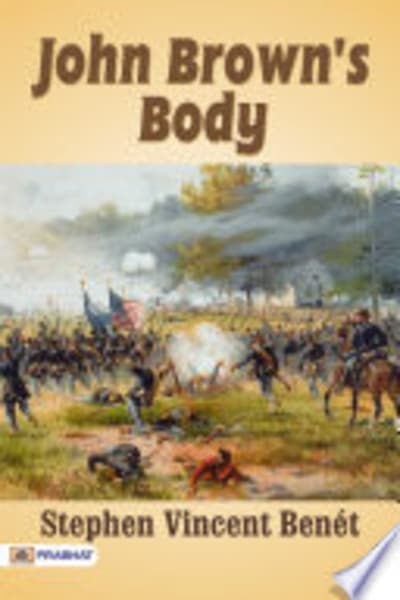
John Brown's Body — Book Summary & Review
Last updated:
John Brown's Body Summary
John Brown’s Body is built in four big movements that track the Civil War’s timeline while Benét keeps interrupting the spectacle with a grim, churchy chorus of meaning—history as both pageant and moral argument. Benét’s method is to treat events like episodes in an epic and then lace them with political memory: John Brown’s 1859 raid at Harpers Ferry becomes the poem’s ignition point, and the war that follows is framed as the country finally catching up to that earlier violence. The poem’s most memorable device is its recurring “chorus” energy, where the poem sounds like a public service sermon that can’t stop sweating over the cost of freedom. You feel that structure most clearly when the narrative shifts from the raid’s aftershock to the war’s mass mobilization, and when Benét uses the “Battle Hymn” rhythm to make marching, dying, and reorganizing feel spiritually charged rather than merely strategic.
Benét also has a distinct argument: the war isn’t only a fight over policy; it’s a reckoning with a national lie, and the poem keeps returning to how ordinary people get swept into a cause they barely understand. Even when the details blur into grand strokes, Benét’s voice stays stubbornly ethical. He returns to Brown not as a saint but as a historical fuse, and he makes you watch how that fuse spreads through time. The historical sweep is wide enough to include political shifts and military developments, but Benét’s real target is the reader’s comfort: he keeps asking what you think “justice” means when it arrives through blood.
Limitation: if you want tight, scene-by-scene realism or a conventional narrative arc with psychologically rounded characters, Benét’s epic-poem form will frustrate you. It’s also long on public rhetoric and short on the kind of private interiority that modern novel readers often crave.
Key Takeaways from John Brown's Body
-
1
John Brown’s Raid Framework: Benét treats 1859 as the war’s ignition, so later battles read like consequences, not separate stories.
-
2
Epic Four-Movement Structure: the poem advances through major war phases while repeatedly pausing to reframe what those phases mean.
-
3
Chorus Device: recurring collective voice turns history into sermon-like commentary, pushing moral interpretation over mere chronology.
-
4
Battle Hymn Rhythm: Benét’s marching cadence makes mass violence feel ritualized, heightening the poem’s ethical pressure.
-
5
Benét’s Moral Reckoning: the war is portrayed as a national correction for earlier hypocrisy, not only policy conflict.
Who Should Read This
If you’re tired of Civil War history that stays safely in footnotes and want a moral, musical argument instead, this will land. Someone who’s been thinking about how earlier acts of violence echo through decades will appreciate how Benét links Brown to the war’s later logic.
Who Shouldn't Read This
If you need character intimacy and psychologically detailed scenes, Benét’s public-voice epic style will feel cold and floaty. If you hate long-form poetry that prioritizes rhetoric and pattern over plot, you’ll likely quit before the poem finds its stride.
Editor's Verdict
John Brown’s Body is at its best when Benét uses the chorus-like public voice to turn the war’s timeline into an ethical reckoning, especially as the poem pivots from Brown’s raid into the war’s mass mobilization. The real limitation is that the epic-poem sweep sacrifices private character depth for public meaning, so it can feel rhetorical when you want specificity. This hits hardest for anyone rereading American history after a political disappointment and realizing how often “later” is just blood catching up.
Ready to read John Brown's Body?
Get your copy on Amazon today.
John Brown's Body — Frequently Asked Questions
About Stephen Vincent Benét
Stephen Vincent Benét (1898–1943) was an American writer and poet from Pennsylvania. He served in World War I and later wrote extensively about American history and national themes. He is credible on John Brown’s Body because he researched and dramatized the Civil War–era abolitionist subject in verse after studying its historical context. His other notable works include the poetry collection John Brown’s Body (1928) and the novel The Devil and Daniel Webster (1937).