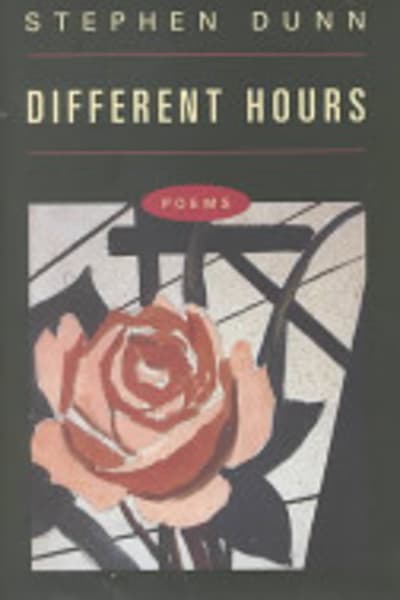
Different Hours — Book Summary & Review
by Stephen Dunn
Last updated:
Different Hours Summary
In Different Hours, Stephen Dunn organizes the book around repeated “hours” as a way to measure eros and thanatos in lived time—desire and decay showing up in the same calendar. The poems don’t treat love and death as separate topics; Dunn keeps yanking them into the same room, then watches what that closeness does to attention. You feel his interest in the endurance of mind and body when both start to diminish, but he refuses to turn that into a tidy moral. Instead, Dunn builds a pattern: the speaker notices sensation, then time interrupts, then memory edits the scene, and finally the poem lands in a kind of acceptance that still aches.
One concrete example is how Dunn returns to bodily language—breath, skin, muscle—then twists it toward mortality without announcing the twist. Another is the way he uses tonal shifts like a structural device: tenderness arrives, then a harsher image of limitation follows, and the poem’s argument becomes emotional rather than logical. Even at ~128 pages, the book feels dense because Dunn’s lines often carry double work: they describe an intimate moment while quietly asking what intimacy costs as the body ages. If you’re looking for a “chapter” in the prose sense, you won’t get one; the nearest equivalent is the book’s repeated temporal framing, which functions like a recurring section title. Dunn’s method is to let eros and thanatos argue with each other until you stop expecting one to win.
Limitation: Different Hours is not a narrative or explanatory book. If you want clear storyline, biographies of the speaker, or step-by-step themes spelled out, Dunn’s lyric compression will frustrate you.
Key Takeaways from Different Hours
-
1
Hour-structure: Dunn uses recurring “hours” to make desire and death feel like consecutive entries in the same day.
-
2
Eros/Thanatos pairing: Each poem puts love-side imagery beside decay-side imagery so the emotions collide rather than alternate.
-
3
Bodily attenuation: Dunn treats diminishing body and mind as a sensory problem, not a philosophical abstraction.
-
4
Memory as editor: Recollection in Different Hours acts like revision, changing what the speaker thinks happened and why it matters.
-
5
Lyric argument: Dunn’s claims arrive through tonal shifts and imagery, so meaning is felt before it’s explained.
Who Should Read This
Someone who’s been trying to name what aging, grief, or ongoing desire is doing to their daily attention will feel seen by Dunn’s hour-by-hour framing. If you read poetry the way you read weather—watching how mood and body change together—Different Hours will likely land.
Who Shouldn't Read This
If you want a linear plot, section-by-section thesis, or guidance for “how to think” about eros and thanatos, Stephen Dunn won’t provide it. If you dislike poems that lean on compression and tonal ambiguity, Dunn’s lyric method may feel withholding rather than rewarding.
Editor's Verdict
Different Hours is at its best when Dunn braids bodily sensation with mortality pressure, using the book’s recurring “hours” frame to keep eros and thanatos in the same emotional field. The limitation is that the book offers no narrative scaffolding or explanatory commentary—only lyric compression that expects you to do some work. This will hit hardest for anyone in midlife who’s suddenly aware of physical limits and wants poetry that treats that awareness as intimate, not inspirational.
Ready to read Different Hours?
Get your copy on Amazon today.
Different Hours — Frequently Asked Questions
About Stephen Dunn
Stephen Dunn (1925–2004) was an American poet and academic. He taught at institutions including the University of Iowa and served as a longtime professor of creative writing. Dunn’s credibility on “Different Hours” comes from his decades of published poetry and his extensive work as a teacher and critic of poetry. He received major honors including the Pulitzer Prize for Poetry (for “Different Hours”). Other notable works include “The World’s Body” and “Attic: Poems.”