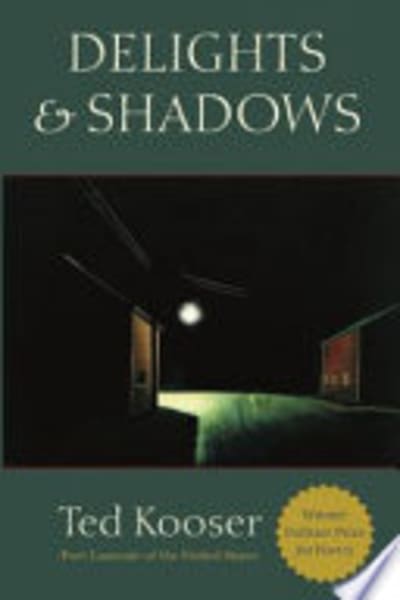
Delights & Shadows — Book Summary & Review
by Ted Kooser
Last updated:
Delights & Shadows Summary
In Delights & Shadows, Ted Kooser organizes the book as a sequence of short poems that repeatedly return to a single craft problem: how to let ordinary Midwestern scenes carry moral weight without announcing the lesson. Kooser’s poems often feel built around a quiet pivot—an image of light on a field, a kitchen detail, a conversation overheard—and then a second, shadow-side meaning that arrives almost sideways. A good example is the poem “Delights and Shadows,” which gives the title its logic: joy and loss aren’t separate categories; they share the same frame, and the speaker learns to keep both in view. Kooser also works in recurring modes: the plainspoken narrative voice, the controlled turn at the end, and the way he trusts a reader to notice what’s missing. When you read him, you start to see how Kooser’s restraint is the engine—he avoids theatrical emotion, but he doesn’t avoid feeling. Another concrete example is “The Summer Day,” where Kooser uses small sensory facts to create a mood of attention; the poem’s meaning isn’t explained, it’s performed by the pacing of what you’re allowed to see. The limitation is real, though: this isn’t a book that argues in the way an essayist does, and it won’t satisfy anyone hunting for a thesis, a “craft system,” or a clear emotional arc across the whole 92 pages. If you want poems that shout their themes, Kooser’s method will feel like slow weather. But if you’re willing to read closely and sit with the turn from light to shadow, Kooser rewards that patience with a kind of moral clarity that never needs a speech.
Key Takeaways from Delights & Shadows
-
1
Delights & Shadows frame: Kooser treats joy and grief as coexisting tones, not separate moods, so the title becomes a reading method.
-
2
Quiet pivot endings: Many poems hinge on a last-line turn that reinterprets the earlier scene without spelling out the lesson.
-
3
Plainspoken narrative voice: Kooser’s speakers sound conversational, which makes the emotional shift feel earned rather than manufactured.
-
4
Attention through sensory detail: Kooser builds meaning by selecting a few concrete perceptions and letting them set the poem’s ethical temperature.
-
5
Restraint as craft: Kooser’s minimalism isn’t emptiness; it’s a deliberate refusal to over-explain what the reader can feel.
Who Should Read This
Someone who’s tired of poems that feel performative—where the point is announced before the image—should read Kooser for his controlled turns and plain voice. If you’re the kind of reader who wants your emotions earned through close attention, this short volume will suit you right now.
Who Shouldn't Read This
If you need a clear argument, chapter-by-chapter progression, or a consistent narrative arc, Kooser’s poetry collection will frustrate you. If you prefer lush, high-volume lyricism with big gestures, his restraint may feel too modest to justify the time.
Editor's Verdict
The best thing Delights & Shadows does is show how Kooser turns everyday specifics into ethical meaning, especially in “Delights and Shadows,” where light and loss share one frame. The limitation is that it offers almost no explicit guidance—no essay-like scaffolding—so you have to supply your own interpretation. This hits hardest for anyone who’s mid-career and quietly questioning how to live with mixed feelings without turning them into a speech.
Ready to read Delights & Shadows?
Get your copy on Amazon today.
Delights & Shadows — Frequently Asked Questions
About Ted Kooser
Ted Kooser is an American author and former journalist and editor, known for writing about poetry and the Midwest. He is credible on the topic of Delights & Shadows because he has long published literary work and has extensive experience shaping and reviewing writing. Kooser’s notable books include Delights & Shadows and The Poetry Home Repair Manual.