Cosmos — Book Summary & Review
by Carl Sagan
Last updated:
Cosmos Summary
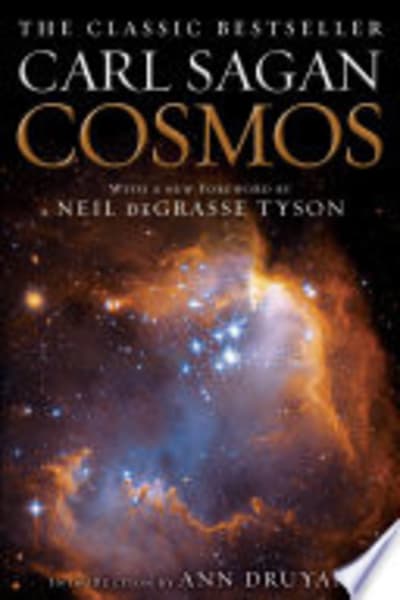
In Cosmos, Sagan introduces us to the 'Cosmic Calendar', a tool that compresses the history of the universe into a single year to help us grasp the vastness of cosmic time. The book is meticulously structured, weaving together history, science, and philosophy to illustrate how these domains are inextricably linked. Sagan's exploration of the Library of Alexandria offers a poignant reminder of the fragility of knowledge and the importance of preserving it. Through chapters like 'Who Speaks for Earth?' he contemplates the role humanity plays in the universe. However, readers looking for detailed scientific equations or deep technical analysis might find Cosmos lacking, as it focuses more on narrative and philosophy than hard science.
Key Takeaways from Cosmos
-
1
Cosmic Calendar: A visualization tool that scales the universe's timeline into one year, making cosmic history comprehensible.
-
2
The Library of Alexandria: A historical example of how knowledge can be lost, emphasizing the need to protect information.
-
3
Who Speaks for Earth?: A chapter addressing humanity's responsibility and potential impact on the universe.
-
4
The Drake Equation: Sagan explains this formula to estimate the number of technological civilizations in our galaxy.
-
5
Pale Blue Dot: A metaphor illustrating Earth's smallness in the vast cosmos, urging humility and stewardship of our planet.
Who Should Read This
Someone who feels overwhelmed by the enormity of the universe and seeks a philosophical yet accessible perspective on human existence. If you're curious about how science, history, and philosophy intertwine to shape our understanding of the cosmos, this book is for you.
Who Shouldn't Read This
If you're looking for a textbook filled with equations and detailed scientific data, Cosmos won't meet your needs. Sagan's narrative style might also frustrate readers who prefer linear, fact-driven science writing.
Editor's Verdict
Cosmos excels at contextualizing science within the broader human experience, particularly in 'Who Speaks for Earth?'. However, its narrative focus may disappoint those seeking rigorous scientific analysis. This book is perfect for anyone grappling with the philosophical implications of our place in the universe.
Ready to read Cosmos?
Get your copy on Amazon today.
Cosmos — Frequently Asked Questions
About Carl Sagan
Carl Sagan was an American astronomer, astrophysicist, and author, born on November 9, 1934, in Brooklyn, New York. He earned his Ph.D. in astronomy and astrophysics from the University of Chicago. Sagan was a credible figure in popularizing science, particularly through his 1980 book "Cosmos," which was accompanied by a successful television series. He also wrote "The Dragons of Eden," which won the Pulitzer Prize, and "Pale Blue Dot," further establishing his influence in science communication.