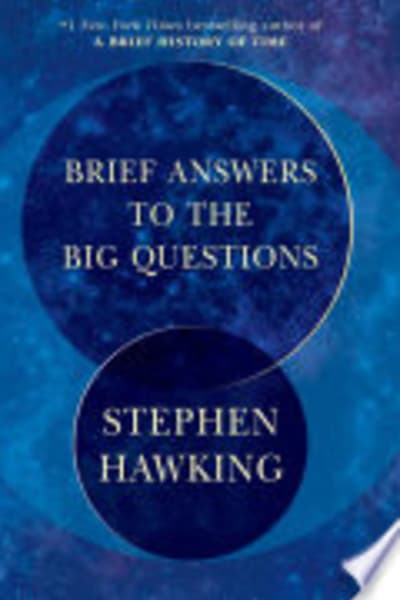
Brief Answers to the Big Questions — Book Summary & Review
Last updated:
Brief Answers to the Big Questions Summary
In 'Brief Answers to the Big Questions,' Hawking organizes his thoughts around ten fundamental questions, each explored in its own chapter. For instance, in 'Is There a God?', Hawking argues from a scientific perspective, offering his views on religion and science in a way that is both accessible and challenging. The book shines with Hawking's unique ability to simplify complex topics like black holes and artificial intelligence. Each chapter is prefaced by insights from notable thinkers, adding layers to his arguments. However, if you're seeking in-depth scientific explanations, you might find the book more philosophical than technical. While Hawking's humor and personal anecdotes enrich the narrative, those looking for a purely scientific discourse might be left wanting more depth in the theoretical physics domain.
Key Takeaways from Brief Answers to the Big Questions
-
1
Time Travel: Hawking discusses the possibilities and limitations of time travel through the lens of physics.
-
2
Black Holes: The book explains Hawking’s groundbreaking views on black holes, including the concept of Hawking radiation.
-
3
Climate Change: Hawking warns of the urgent need to address climate change, emphasizing scientific responsibility.
-
4
Extraterrestrial Life: Hawking speculates on the existence of extraterrestrial life and the implications for humanity.
-
5
AI Risks: Hawking highlights the potential dangers of artificial intelligence, advocating for cautious development.
Who Should Read This
If you're grappling with understanding the intersection of science and philosophy, this book offers a thoughtful perspective. Someone who appreciates Hawking's wit and insight into life's big questions will find it rewarding.
Who Shouldn't Read This
If you're expecting an in-depth technical breakdown of Hawking's scientific theories, this book will disappoint. Someone looking for a detailed, textbook-style exposition on physics might find the philosophical approach frustrating.
Editor's Verdict
Hawking's best achievement here is making complex scientific topics like artificial intelligence and black holes approachable. The limitation lies in its occasional lack of scientific depth, which might frustrate those looking for rigorous detail. Anyone questioning humanity's future or wrestling with philosophical questions about existence will find it most impactful.
Ready to read Brief Answers to the Big Questions?
Get your copy on Amazon today.
Brief Answers to the Big Questions — Frequently Asked Questions
About Stephen Hawking
Stephen Hawking was a renowned theoretical physicist and cosmologist, born on January 8, 1942, in Oxford, England. He earned his Ph.D. from the University of Cambridge, where he later served as the Lucasian Professor of Mathematics. Hawking is credible due to his groundbreaking work on black holes and the nature of the universe. Besides "Brief Answers to the Big Questions," he authored "A Brief History of Time" and "The Universe in a Nutshell," contributing significantly to popular science literature.