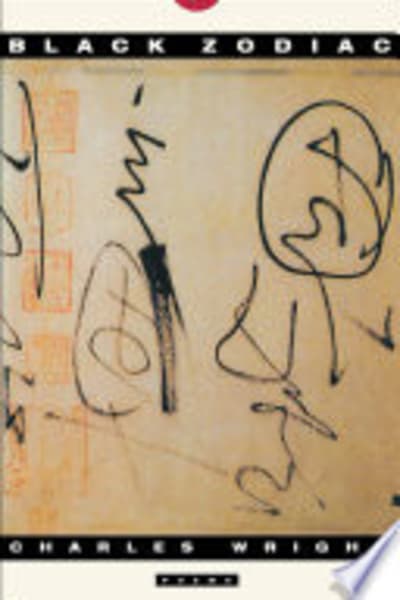
Black Zodiac — Book Summary & Review
Last updated:
Black Zodiac Summary
Black Zodiac arranges Charles Wright’s poems like a set of brief, shifting “envoi” arguments—each piece circles a mood, then snaps it into a different angle, until the book’s framework feels less like story than pressure. Wright’s Envoi line about “No angst in the anthill” is the center of gravity: he’s pushing back against the idea that life must be explained through suffering, and he keeps testing the claim that events only feel fated because we keep narrating them. The book’s structure matters because it refuses a steady, linear movement; instead, Wright gives you clusters of reflection where the speaker seems to stand outside his own thoughts, watching them assemble and dissolve.
A concrete example: in the Envoi framing, Wright insists that “what happened… never existed to start with,” which reads like metaphysics but lands as a craft lesson—your mind manufactures a past to stabilize the present. Another example shows up in how the poems keep returning to New York as a kind of weather system. Wright uses the city’s grit and density the way some writers use mythology: not to decorate, but to show how quickly meaning gets assigned, then reassigned, depending on where you’re standing. By the end, Wright’s point isn’t that nothing matters; it’s that your “today” is partly a story you tell yourself, and the story can be edited.
Honest limitation: Black Zodiac is short and deliberately oblique. If you want narrative payoff, named characters, or a clear thesis you can quote and apply, Wright will frustrate you; this book works best when you’re willing to sit with ambiguity and reread lines for tone.
Key Takeaways from Black Zodiac
-
1
Envoi stance: Wright argues that suffering isn’t the engine of meaning; life happens, and we retrofit angst afterward.
-
2
No angst in the anthill: The poems treat pain as a mental habit, not a spiritual requirement for insight.
-
3
What happened… never existed: Wright frames memory as construction, so the past is editable rather than fixed evidence.
-
4
No next and no before: The book flattens time into present perception, making “today” feel like a choice.
-
5
New York as weather: Wright uses place to show how meaning shifts with attention, not with plot.
Who Should Read This
Someone who keeps looping on “what this all means” after a hard week will appreciate Wright’s refusal to treat angst as proof. If you’re the kind of reader who likes short poems that you can sit with for days, Black Zodiac will match your pace.
Who Shouldn't Read This
If you want a long-form argument with chapter-by-chapter clarity, Wright’s compact, non-linear structure will feel slippery and unfinished. If you need emotionally explicit catharsis—grief laid out, then resolved—this book’s metaphysical distance will disappoint you.
Editor's Verdict
Charles Wright’s strongest move is the Envoi logic—especially the claim that the past “never existed to start with”—because it turns poetic mood into a consistent way of thinking. The limitation is simple: Black Zodiac is only about 85 pages and offers no guiding narrative thread, so you can’t rely on momentum to carry you. This hits hardest for anyone stuck in the “my suffering must explain me” mindset, especially during a period of burnout when you can’t face more self-help certainty.
Ready to read Black Zodiac?
Get your copy on Amazon today.
Black Zodiac — Frequently Asked Questions
About Charles Wright
Charles Wright is an American poet and essayist known for writing about race, history, and American life. He is credible on these topics through his long career producing award-winning work that engages with Black experience and cultural memory. Wright has published numerous collections, including Black Zodiac, and earlier acclaimed books such as Black Zodiac’s companion volume, The Messenger (1991), and To See the Earth (1995).