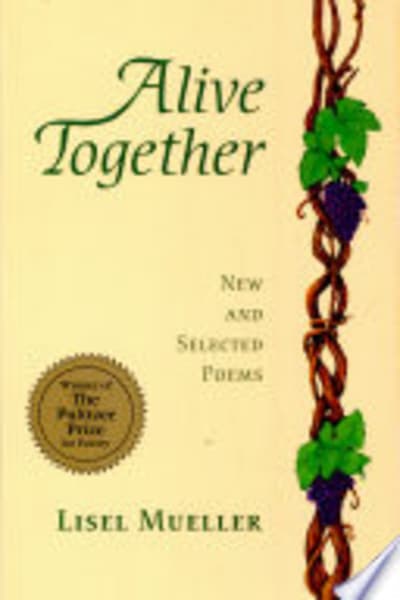
Alive Together: New and Selected Poems — Book Summary & Review
Last updated:
Alive Together: New and Selected Poems Summary
Lisle Mueller’s Alive Together is organized around the push-pull between lyric intimacy and historical pressure, and you feel that structure in how the poems keep returning to family, displacement, and the moral weight of witness. Mueller doesn’t offer a tidy thesis so much as a recurring method: she writes poems that behave like rooms—some bright, some suffocating—where the speaker has to keep living anyway. In the early section, the poems move with a plainspoken musicality, but the emotional logic is never “comfort first.” Instead, Mueller repeatedly stages what she seems to call togetherness as a practice, not a sentiment: being alive alongside others even when history has made that proximity feel fragile.
One concrete example is her use of recurring motifs—hands, voices, and domestic objects—that reappear as if they’re trying to hold the line against erasure. Another is the way Mueller’s images often arrive with a second meaning attached, so a seemingly ordinary scene can suddenly carry the aftertaste of exile or loss. The title Alive Together lands because the poems keep testing whether survival is solitary or communal, and they lean toward communal, even when the community is only implied by memory.
Mueller’s limitation is real: this is not a book that supplies context like a tour guide. If you want biographical scaffolding on every poem, or you need straightforward narrative arcs, you may find the collection frustratingly elliptical. It also isn’t a “one mood” experience; the emotional register shifts sharply, and readers looking for consistent buoyancy should prepare for the darker turns. Still, if you’re willing to read slowly and let the poems argue by repetition, Mueller’s voice earns its insistence on staying human together.
Key Takeaways from Alive Together: New and Selected Poems
-
1
Alive Together as practice: Mueller treats togetherness as something you do—through memory, speech, and stubborn attention.
-
2
Lyric witness: Poems function like testimony without footnotes, carrying history in images rather than explanations.
-
3
Recurring motifs of hands and voices: These objects return as emotional evidence, not decoration, shaping how loss is measured.
-
4
Elliptical structure: The collection withholds context, so meaning emerges from patterns you notice over multiple poems.
-
5
Survival’s communal angle: Mueller repeatedly frames endurance as shared presence, even when community is broken or distant.
Who Should Read This
Someone who’s been craving poetry that keeps its moral seriousness without turning into a lecture will likely feel at home here. If you’ve spent too long reading work that either flinches away from history or over-explains it, Mueller’s method will feel bracing.
Who Shouldn't Read This
If you need clear narrative progression and authorial guidance, Mueller’s elliptical approach will frustrate you. If you only want poems that stay emotionally light, the collection’s recurring pressure of loss and displacement will wear you down.
Editor's Verdict
The single best thing Mueller does is make togetherness feel earned through repetition—hands, voices, and domestic images keep returning like a promise tested under strain. The real limitation is that Alive Together refuses to provide reliable context, so readers who want background for each poem will feel stranded. This hits hardest for anyone reading after a personal rupture—especially if you’re trying to figure out whether you’re surviving alone or still being held by others’ echoes.
Ready to read Alive Together: New and Selected Poems?
Get your copy on Amazon today.
Alive Together: New and Selected Poems — Frequently Asked Questions
About Lisel Mueller
Lisel Mueller (1924–2023) was a German-American poet born in Germany who immigrated to the United States, where she taught and wrote extensively. She is credible on themes of displacement, memory, and survival because her life included persecution under Nazism and later relocation. Her poetry is widely anthologized and studied. Other notable works include The Need to Hold Still and The Poems of Lisel Mueller.