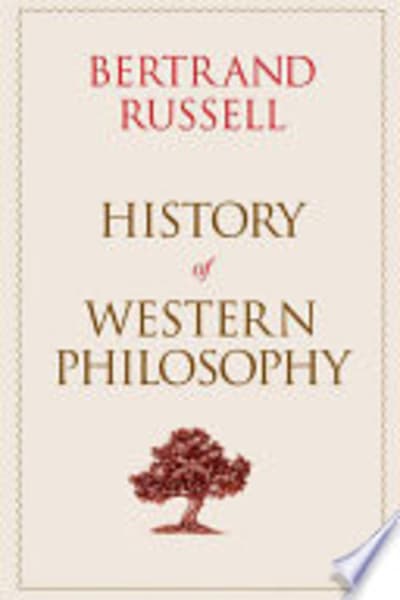
A History of Western Philosophy — Book Summary & Review
Last updated:
A History of Western Philosophy Summary
Russell opens with "The Rise of Greek Civilization," emphasizing how Greek philosophy laid the groundwork for Western thought. The book is meticulously structured into distinct historical periods, allowing readers to trace the evolution of philosophical ideas from ancient Greece to the early 20th century. Russell excels in making intricate concepts accessible, such as his exploration of the 'Social Contract' in the chapter on Rousseau, which ties philosophy directly to political movements. His wry wit and sharp critiques are present throughout, providing not just an overview but a conversational critique of major philosophical figures. However, the book doesn't cater to those seeking contemporary philosophical discourse; it stops short at the early 20th century. While Russell's approach is insightful, his interpretations may frustrate readers looking for more detailed treatment of each philosopher's original works.
Key Takeaways from A History of Western Philosophy
-
1
The Rise of Greek Civilization: Russell argues this period laid the foundation for Western philosophical thought.
-
2
Social Contract: Explored in Rousseau's chapter, connecting philosophy to key political movements and ideas.
-
3
Empiricism vs Rationalism: Russell contrasts these approaches, illustrating their influence on Western philosophy.
-
4
Hegelian Dialectic: Discussed in Hegel's section, emphasizing the process of thesis-antithesis-synthesis in history.
-
5
Philosophy and Politics: Russell insists on the intertwined evolution of philosophical ideas and political contexts.
Who Should Read This
Someone who feels overwhelmed by the vastness of Western philosophy and needs a focused, historical roadmap. If you're building a foundational understanding before tackling original texts, this is your guide.
Who Shouldn't Read This
If you're seeking insights into post-World War II philosophical developments, this book won't satisfy you. Russell halts his analysis in the early 20th century, leaving out modern thinkers.
Editor's Verdict
The best feature of this book is how Russell articulates the 'Hegelian Dialectic' with clarity and wit. Its real limitation is the lack of coverage on modern philosophical developments, stopping at the early 20th century. Ideal for anyone embarking on a historical study of philosophy before diving into primary sources.
Ready to read A History of Western Philosophy?
Get your copy on Amazon today.
A History of Western Philosophy — Frequently Asked Questions
About Bertrand Russell
Bertrand Russell (1872–1970) was a British philosopher, logician, and social critic, renowned for his significant contributions to analytical philosophy and the philosophy of mathematics. He was educated at Trinity College, Cambridge, where he later became a fellow. Russell's credibility in philosophy is underscored by his extensive scholarly work, including "Principia Mathematica," co-authored with Alfred North Whitehead, and "The Problems of Philosophy." His book, "A History of Western Philosophy," remains a seminal text in the field.