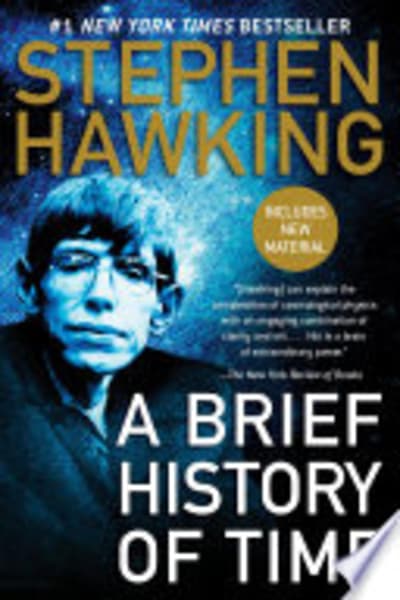
A Brief History of Time — Book Summary & Review
Last updated:
A Brief History of Time Summary
Hawking’s A Brief History of Time opens with the idea of “Imaginary Time” and what it suggests about how we understand the universe. From black holes to the nature of time, he moves through heavyweight concepts with a practiced clarity that avoids the usual fog—though he never quite commits to the level of technical detail skeptics would demand. The section “The Arrow of Time” is a standout for its discussion of time’s direction and how that shapes our perception of reality. Across the book, Hawking constantly toggles between layman-friendly language and scientific discipline, a strength that also becomes its Achilles’ heel. Most readers will appreciate how he ties abstract cosmology to everyday intuition, but anyone looking for a rigorous, equation-heavy education may feel shortchanged.
Key Takeaways from A Brief History of Time
-
1
Imaginary Time: A theoretical construct that allows for a different view of the universe's origin and future.
-
2
The No-Boundary Proposal: Hawking's idea that the universe has no boundaries, leading to a finite yet unbounded concept of space-time.
-
3
The Arrow of Time: Explains the distinction between the past and future directions in time, rooted in thermodynamics.
-
4
Black Holes: Describes how these regions of space with intense gravity affect time and space, and can emit radiation.
-
5
Unified Theory: Hawking’s belief in a single, coherent framework uniting relativity and quantum mechanics, still sought after today.
Who Should Read This
If you’re someone grappling with the vastness of cosmological ideas or questioning the nature of time itself, this book is for you. Someone who enjoys making sense of complex scientific theories without needing to understand detailed mathematics will find value here.
Who Shouldn't Read This
If you’re a professional physicist looking for rigorous mathematical discourse, Hawking’s explanations might feel superficial. Those who prefer a narrative style or personal stories may find the scientific focus too dry.
Editor's Verdict
The most impressive aspect of this book is Hawking’s explanation of 'The No-Boundary Proposal', which challenges our understanding of time. However, the book doesn’t provide the mathematical depth that some science enthusiasts might crave. Anyone at the start of their journey into cosmology and theoretical physics will find this book a fascinating starting point.
Ready to read A Brief History of Time?
Get your copy on Amazon today.
A Brief History of Time — Frequently Asked Questions
About Stephen Hawking
Stephen Hawking was a renowned theoretical physicist and cosmologist born on January 8, 1942, in Oxford, England. He was a professor at the University of Cambridge and made significant contributions to the understanding of black holes and the nature of the universe. His credibility on the topic is underscored by his groundbreaking work on Hawking radiation. Besides "A Brief History of Time," he authored "The Universe in a Nutshell" and "The Grand Design."