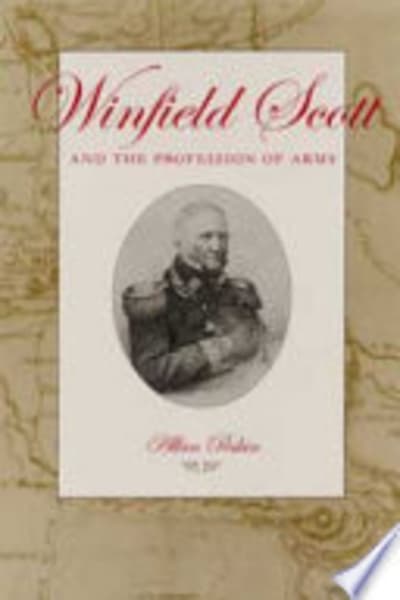
Winfield Scott and the Profession of Arms — Book Summary & Review
by Allan Peskin
Last updated:
Winfield Scott and the Profession of Arms Summary
In Winfield Scott and the Profession of Arms, Allan Peskin organizes the biography around Scott’s administrative method—especially how he tried to turn battlefield experience into a repeatable system inside the U.S. Army. Peskin’s central argument is that Scott was a manager before he was a myth: he pushed paperwork, training routines, logistics thinking, and organizational reforms as if he were running an early version of “modern” defense administration. A concrete example appears when Peskin stresses Scott’s use of War Department records to document what the army needed, not simply what it wished for. The book also leans hard on Scott’s ability to forecast change—Peskin repeatedly frames him as someone who saw that technology, transport, and the business-like logic of systems would matter more as the century moved on.
One of the book’s most useful threads is how Peskin links Scott’s professionalization drive to specific historical flashpoints: the War of 1812, the Mexican War, and the Civil War all become testing grounds for whether Scott’s ideas survived contact with politics and patronage. Even when Peskin can’t resolve every contradiction in Scott’s character, he keeps returning to a pattern: Scott treats the Army as an institution that can be engineered through standards and planning. In the chapter-focused sections Peskin foregrounds Scott’s long career, showing how reforms were incremental, resisted, and sometimes reversed.
The limitation is straightforward: this is not a narrative biography for readers who want constant action. Peskin’s archive-heavy approach can feel slow, and the book’s most satisfying payoffs are aimed at people who care about institutional history more than battlefield drama.
Key Takeaways from Winfield Scott and the Profession of Arms
-
1
War Department records: Peskin uses archival material to show Scott’s reforms were administrative decisions, not just battlefield reputation.
-
2
Professionalization of the U.S. Army: Scott treats training, logistics, and procedures as an institution you can standardize over time.
-
3
Forward-looking managerial officer: Peskin argues Scott anticipates technology and organizational change with business-like planning habits.
-
4
Mexican War test: Scott’s ideas are measured against political friction and the Army’s uneven ability to translate plans into practice.
-
5
Civil War institutional pressure: Peskin shows how Scott’s professional ideals collide with wartime improvisation and patronage networks.
Who Should Read This
Someone who keeps running into the same question—how the U.S. Army became a professional institution instead of a patchwork of personalities—will get real traction here. If you’re studying 19th-century military administration or writing about command culture, Peskin’s record-driven approach will feel directly useful.
Who Shouldn't Read This
If you want a fast, scene-by-scene military story, you’ll likely find Peskin’s emphasis on institutional change and documentation frustrating. If you’re looking for a broad, casual overview of Scott’s life with minimal archival detail, this book will feel denser than you bargained for.
Editor's Verdict
Peskin’s best move is tying Scott’s professionalization agenda to specific administrative behaviors, supported by War Department materials, so Scott reads like a reformer with receipts. The limitation is that the book is frequently more institution-and-record than character-and-crisis, which can slow the momentum for general readers. This hits hardest for anyone researching mid-career questions about why organizations need systems—especially if you’re tired of “hero biography” and want how institutions actually change.
Ready to read Winfield Scott and the Profession of Arms?
Get your copy on Amazon today.
Winfield Scott and the Profession of Arms — Frequently Asked Questions
About Allan Peskin
Allan Peskin was an American historian and author specializing in U.S. military history and the antebellum and Civil War eras. He earned his academic training in history and wrote extensively on nineteenth-century American military institutions and leadership. Peskin is credible on Winfield Scott and the U.S. Army because his scholarship focuses on primary-source research and detailed institutional analysis of the period. Other notable works include War and the American Army and The Old Army in a New Nation.