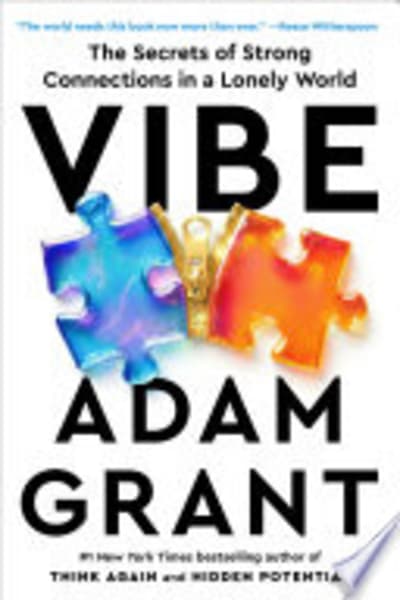
Vibe — Book Summary & Review
by Adam Grant
Last updated:
Vibe Summary
In Vibe, Adam Grant builds a relationship framework around “chemistry,” “similarity,” and “closeness” as separate levers, then tests each one with real studies and real group stories. The book opens by treating loneliness and polarization as partly communication problems: when face-to-face contact shrinks and conversation gets outsourced to screens and AI, we lose the micro-signals that make people feel safe enough to connect. Grant’s strongest chapters—especially the section that focuses on “similarity isn’t required for solidarity” (he returns to the idea with multiple experiments)—argue that shared values, cooperative goals, and perceived fairness can substitute for shared identity. He also keeps puncturing the myth that closeness is mostly fast chemistry: in one of the recurring examples, he follows groups where trust grows through repeated, low-stakes interaction rather than dramatic bonding.
Grant’s best concrete set pieces are the crew of astronauts who had to trust people they didn’t like, and the journalist who designed a structured gathering that reportedly led to dozens of marriages. Those aren’t just feel-good anecdotes; Grant uses them to show how predictable formats—clear roles, time for small talk, and planned “glue moments”—reduce social friction. He even zooms in on his own arc from shy introvert to an enthusiastic convener, which matters because it keeps the advice from feeling like abstract coaching.
The limitation: Vibe is light on step-by-step exercises you can run like a template, and it leans heavily on research summaries that some readers will find more academic than practical.
Enjoyed this one? Read these next.
Top picks in Non-Fiction, chosen for readers of Vibe.
Sapiens
by Yuval Noah Harari
Check price on Amazon
Educated
by Tara Westover
Check price on Amazon
Becoming
by Michelle Obama
Check price on Amazon
The Wright Brothers
by David McCullough
Check price on AmazonKey Takeaways from Vibe
-
1
Chemistry as a variable: Grant treats “chemistry” as something you can steer with context and repeated interaction, not a random spark.
-
2
Similarity isn’t required for solidarity: Shared identity helps, but values, cooperation, and fairness cues can create belonging without sameness.
-
3
Closeness doesn’t always take time: He argues timing matters, but structure can compress bonding by lowering risk and increasing responsiveness.
-
4
Planned social formats: Grant highlights that gatherings with roles and glue moments outperform vague “just be yourself” advice.
-
5
Vibe-building behaviors: He connects group closeness to small, observable actions—attention, turn-taking, and follow-through—over personality traits.
Who Should Read This
If you’re stuck in the same work-and-friends loop and feel like your relationships keep stalling, Vibe gives you a way to redesign interactions. Someone who freezes in awkward moments—then scrolls instead—will appreciate how Grant separates chemistry, similarity, and closeness so you can act anyway.
Who Shouldn't Read This
If you want a strict, timed program with worksheets and daily drills, Grant’s research-heavy approach will feel frustratingly unspecific. If you already hate academic citations and prefer purely narrative self-help, Vibe’s structure may feel like reading studies wearing a friendly voice.
Editor's Verdict
The single best thing Vibe does is use the astronauts example to show how trust can grow through controlled exposure, not mutual likability, and Grant ties it back to his “chemistry” framework. The real limitation is that Grant rarely turns his findings into a concrete, repeatable practice plan you can follow the next day. This book hits hardest for anyone newly back in social life—after a move, a breakup, or a burnout—when you need a rational way to rebuild closeness without waiting for perfect vibes.
Ready to read Vibe?
Get your copy on Amazon today.
Vibe — Frequently Asked Questions
About Adam Grant
Adam Grant is an organizational psychologist and author. He earned a PhD from the University of Michigan and teaches at the Wharton School of the University of Pennsylvania. He studies motivation, workplace behavior, and how teams influence one another. He’s credible on “vibe” because his research and writing focus on culture, communication, and performance dynamics. Notable works include Give and Take and Originals.