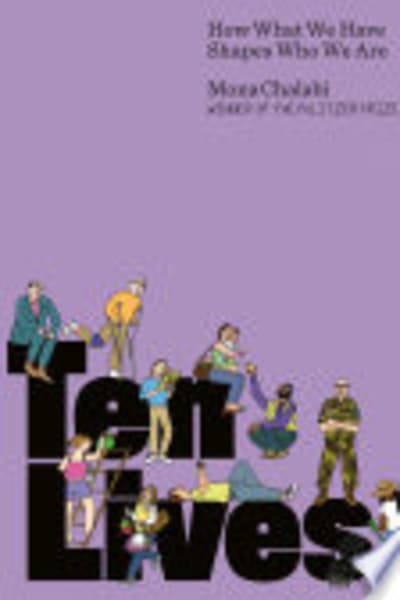
Ten Lives — Book Summary & Review
by Mona Chalabi
Last updated:
Ten Lives Summary
Ten Lives structures its argument around ten named lives—then keeps interrupting the stories with Mona Chalabi’s data-visualization findings about what money can’t buy, what it can, and what it quietly decides for you. The book opens with a set of recurring questions (how much money is enough, what “enough” means under stress, and why people lie to themselves about risk), and Chalabi doesn’t treat those questions as abstract. She follows Anna, whose comfortable mansion-in-Maine life collapses when divorce turns into a family finance problem; Hunter, a veteran whose shame bleeds into benefit choices; and Levi, whose gambling debt becomes a kind of algorithmic treadmill, where each new attempt at control still circles back to the same math. One of the most concrete sections is built around the “good life” problem—Chalabi compares household spending, emergency buffers, and medical shocks, then shows how small gaps in savings turn into big gaps in options. Christian’s arc, tied to Amazon warehouse work and union organizing, is where the book’s thesis clicks hardest: inequality isn’t only income; it’s leverage over time, health, and the ability to bargain for dignity. The strongest pattern across the ten cases is that fear is measurable—interest rates, medical billing, tax timing, and inheritance rules shape what people can imagine doing next. Chalabi also turns the lens on herself, and that’s where the writing earns its edge: her mother’s illness forces the same questions the reporting raised. Honest limitation: the book is less interested in policy mechanics than in lived outcomes, so readers looking for a nuts-and-bolts guide to fixing systems may feel the analysis stays at the level of exposure rather than prescription.
Enjoyed this one? Read these next.
Top picks in Non-Fiction, chosen for readers of Ten Lives.
Sapiens
by Yuval Noah Harari
Check price on Amazon
Educated
by Tara Westover
Check price on Amazon
Becoming
by Michelle Obama
Check price on Amazon
The Wright Brothers
by David McCullough
Check price on AmazonKey Takeaways from Ten Lives
-
1
Ten Lives: Ten personal finance case studies are used as data units, showing how fear and choice track household risk.
-
2
How much money is enough: Chalabi treats “enough” as an emergency-buffer equation, not a lifestyle number or moral score.
-
3
Tax, groceries, inheritances: The book links everyday line items to long-term inequality through timing, rules, and hidden penalties.
-
4
Shame around benefits: Hunter’s story shows how stigma distorts decision-making, even when policies are designed to help.
-
5
Union organizing and leverage: Christian’s workplace organizing illustrates how power at work changes financial stability more than paychecks alone.
Who Should Read This
Someone who keeps doing mental math about rent, medical bills, or debt and feels weirdly alone in that anxiety will find Ten Lives clarifying. If you’ve been asking how money changes your decisions during a crisis, Chalabi’s case-driven approach will make the pattern feel personal and undeniable.
Who Shouldn't Read This
If you want a book that lays out specific legislation, budgets, and step-by-step reforms, Ten Lives will frustrate you with its focus on outcomes over policy architecture. If you dislike data-heavy nonfiction—especially when stories pause for charts and methodology—Chalabi’s visual explanations may feel intrusive.
Editor's Verdict
Ten Lives’ best move is pairing personal narratives with the book’s recurring “enough” framework, then using the data-visualization sections to show how emergency risk behaves across Anna, Hunter, Levi, and Christian. The real limitation is that Chalabi stays mostly at the level of measurement and lived consequence, offering less in the way of concrete policy solutions. Anyone who’s recently had a health scare, watched a family budget implode, or felt their savings evaporate will hit hardest when the book turns from reported lives to Chalabi’s own medical shock.
Ready to read Ten Lives?
Get your copy on Amazon today.
Ten Lives — Frequently Asked Questions
About Mona Chalabi
Mona Chalabi is a data journalist and author based in the UK. She trained as a journalist and became known for explaining complex statistics clearly for general audiences, including through her work at FiveThirtyEight and in major publications. She is credible on animal-counting and population topics because she applies rigorous data analysis and sourcing to public datasets. Her notable books include Ten Lives and The World’s Most Expensive Things.