Washington's Crossing — Book Summary & Review
Last updated:
Washington's Crossing Summary
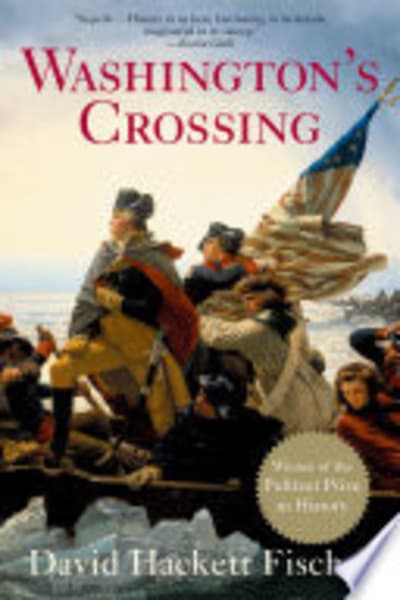
David Hackett Fischer’s Washington’s Crossing is built around a specific political-and-military framework: he argues that Washington’s famous battlefield choices were inseparable from institutional politics, command culture, and the constant fight over legitimacy. The book organizes its case through recurring headquarters realities—who had authority, who controlled information, and how Congress and state governments constrained every move—so the “crossing” becomes more than geography. Fischer’s strongest sequence is his treatment of the Trenton-to-Valley Forge stretch, where he shows how logistics, morale, and political messaging braided together rather than existing as separate stories. He also keeps returning to the way revolutionary leaders tried to manage public meaning: propaganda was not an accessory, it was a weapon. One of the most memorable examples is Fischer’s discussion of how Jefferson’s political maneuvering toward Adams and the use of sedition laws shaped the atmosphere of dissent, turning “loyalty” into a legal and rhetorical cudgel. Fischer similarly spotlights the Hamilton–Burr conflict as a warning signal about how quickly elite rivalries turned into media warfare and personal threats, even while Burr served as Vice President. If you’ve only absorbed Washington as a marble statue, Fischer’s approach can feel bracing: the Revolution looks like a messy system of competing power centers that still managed to function. The honest limitation: Washington’s Crossing does not focus on the day-to-day experience of ordinary soldiers in a sustained, intimate way; it’s heavy on high-level politics, documents, and command decisions, and you’ll feel the book’s weight if you want a faster, character-driven narrative. Fischer isn’t writing to comfort the syllabus version of the past—he’s writing to replace it, and you’ll work for that replacement.
Key Takeaways from Washington's Crossing
-
1
Headquarters as a system: Fischer treats command decisions as political negotiations, not heroic improvisation, especially around Washington’s authority.
-
2
Legitimacy politics: He shows revolutionary “loyalty” enforced through laws and rhetoric, shaping what leaders could safely say or do.
-
3
Trenton’s aftermath: The victory matters because it feeds morale, supply priorities, and political signaling heading into winter.
-
4
Valley Forge constraints: Fischer emphasizes that endurance depended on administration, procurement, and coordination as much as discipline.
-
5
Hamilton–Burr media conflict: He frames public slander and private threats as part of how elite power operated during the Revolution.
Who Should Read This
Someone who’s tired of Revolutionary War history that reads like a list of battles and dates will like how Fischer ties Trenton and Valley Forge to political control. If you’re currently arguing online or in your family about how dissent gets policed, you’ll find the sedition-and-legitimacy thread uncomfortably relevant.
Who Shouldn't Read This
If you want a fast, scene-by-scene narrative with lots of ordinary-soldier interiority, Fischer’s document-heavy headquarters focus will feel cold and repetitive. If you hate long political context and prefer biographies that sprint, you may resent how often the book pauses to map authority and incentives.
Editor's Verdict
Fischer’s best move is using the Trenton-to-Valley Forge sequence to prove his larger claim that military timing and political messaging were inseparable, not sequential. The real limitation is that Washington’s Crossing is structurally political and administrative, so readers looking for intimate battlefield immersion will feel starved. Anyone who has only met Washington through school summaries will hit hardest after the first time Fischer reframes elite conflicts like Jefferson’s and Hamilton–Burr as engines of policy, not background noise.
Ready to read Washington's Crossing?
Get your copy on Amazon today.
Washington's Crossing — Frequently Asked Questions
About David Hackett Fischer
David Hackett Fischer (1938–2023) was an American historian known for narrative scholarship on early American and Atlantic history. He earned a PhD from Harvard University and taught at Brandeis University and elsewhere. Fischer is credible on Washington’s Crossing because he has extensively studied colonial-era politics, military culture, and transatlantic historical context. His notable works include Paul Revere’s Ride (1994) and Albion’s Seed (1989).