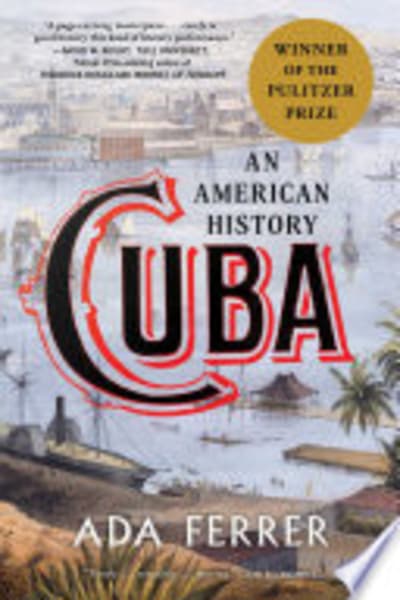
Cuba: An American History — Book Summary & Review
by Ada Ferrer
Last updated:
Cuba: An American History Summary
Ada Ferrer opens Cuba: An American History by framing the U.S.–Cuba relationship as a long, recurring system of interference and exchange rather than a single Cold War episode, and the book’s five-century sweep keeps proving her point. Ferrer organizes the story around turning points in which Washington’s choices—economic, diplomatic, and military—collide with Cuban political actors who are never passive. One of the clearest through-lines arrives when Ferrer tracks how the island’s colonial economy and racial order were shaped by Spain and then reinterpreted through American commerce and policy, setting up the later pattern: the U.S. repeatedly intervenes while claiming it is protecting something “responsible.”
A concrete example that sticks is Ferrer’s attention to the 1898 moment and its aftermath: she treats the Spanish-American War not as a clean handoff of sovereignty, but as a reconfiguration of power that left Cuba negotiating freedom under new pressure. Later, the narrative tightens around the 1961 severing of diplomatic relations and the broader Cold War logic that turned Cuban policies into American talking points and American leverage into Cuban survival tactics. Ferrer’s chapter on the revolution’s early years—how the new regime consolidated authority while the U.S. hardened its stance—shows why the standoff lasted longer than any one president’s intentions.
Still, Ferrer’s ambition is also the book’s limit. If you want a tightly chronological “who did what on which date” guide, you may find the argument-driven structure frustrating, and the prose assumes you can keep multiple political factions straight without much hand-holding.
Key Takeaways from Cuba: An American History
-
1
U.S.–Cuba relationship as system: Ferrer treats policy as a repeating structure of leverage, not a one-off reaction to the Cuban Revolution.
-
2
1898 aftermath lens: She reframes the Spanish-American War as power transfer that reshaped sovereignty negotiations rather than ending dependence cleanly.
-
3
Cold War logic in 1961: The severing of relations is shown as policy momentum—Cuban actions and U.S. responses feeding each other.
-
4
Cuban political agency: Ferrer emphasizes Cuban actors making strategic choices under pressure, not simply “responding” to Washington.
-
5
Revolution consolidation years: The book connects internal consolidation to how Washington interpreted threats and opportunities.
Who Should Read This
Someone who keeps hearing “Cuba was inevitable” narratives from politicians or podcasts should read Ferrer to see how choices, not destiny, built the conflict. If you’re American and tired of simplified Cold War morality plays, this gives you a messier, more historically grounded map of why the standoff endured.
Who Shouldn't Read This
If you want a short, date-stamped overview of U.S. policy toward Cuba, Ferrer’s argument-forward, multi-century structure will feel like too much work. If you dislike dense historical prose that requires tracking institutions, factions, and timelines at once, you’ll likely get annoyed rather than enlightened.
Editor's Verdict
The best part of Cuba: An American History is Ferrer’s insistence that U.S. policy and Cuban agency form a single long feedback loop, especially clear in her treatment of the 1898 aftermath. The real limitation is that the book is built to argue, not to serve as a quick reference timeline of events. Anyone who grew up on simplified “revolution vs. America” stories will hit hardest when Ferrer reframes those categories during the early revolutionary years and their immediate U.S. responses.
Ready to read Cuba: An American History?
Get your copy on Amazon today.
Cuba: An American History — Frequently Asked Questions
About Ada Ferrer
Ada Ferrer is a historian and author of Cuba: An American History. She is a professor of history at New York University and a specialist in U.S.–Latin American relations and Cuban history. Ferrer’s credibility comes from her academic research on Cuba’s political and social history and its connections to the United States, published in scholarly venues and recognized by major academic publishers. Other notable works include Freedom’s Mirror: Cuba and Haiti in the Age of Revolution and Insurgent Cuba: Race, Nation, and Revolution, 1868–1898.