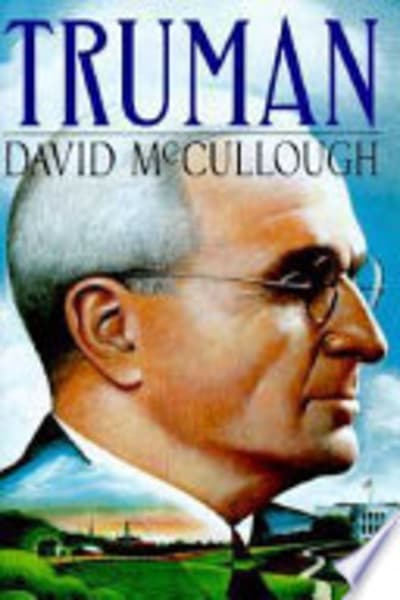
Truman — Book Summary & Review
Last updated:
Truman Summary
McCullough structures Truman with a steady, chronological grip, but he keeps pausing to re-explain how the president’s mind worked—especially around decision-making under pressure. One of the book’s most useful frameworks is McCullough’s insistence on “the man from Missouri” as a working political type: not a mystic, not a genius, but a stubborn administrator who learned in real time. You see it in the run-up to the atomic bomb decision, where McCullough lays out the bureaucratic friction, the competing claims of necessity, and Truman’s own insistence on being briefed rather than swept along. The narrative then tightens around specific set pieces—Potsdam, the Korean War’s early moves, and the firing of General MacArthur—so you’re not just watching events happen; you’re watching a temperament collide with institutional inertia.
McCullough also makes a big point about character as evidence. He doesn’t treat Truman’s folksiness as marketing; he uses it to explain why Truman distrusted grandstanding and why he could be patient with colleagues while still making hard calls. The Whistle-Stop Campaign of 1948 becomes more than a political vignette; it’s the moment McCullough shows Truman’s political instincts catching up with the moral weight of what he’d inherited. And the book’s method—archival material plus interviews—shows up most clearly when McCullough revisits familiar Washington characters like George Marshall, Eleanor Roosevelt, and Dean Acheson and refuses to let you keep a simple “good guys/bad guys” map.
Limitation: this is not a quick, debate-friendly political primer. It’s a dense, long biography that expects you to tolerate extended background on Kansas City politics and Democratic machinery before you get the full emotional payoff of the presidency.
Key Takeaways from Truman
-
1
Truman’s decision style: McCullough portrays him as process-minded, insisting on being briefed and weighing tradeoffs rather than chasing vibes.
-
2
Potsdam pressure: The book shows how summit diplomacy becomes a pressure cooker where information gaps and timing shape policy choices.
-
3
Atomic bomb bureaucracy: McCullough tracks interagency friction to explain how “necessity” was argued, not assumed, inside the administration.
-
4
Whistle-Stop Campaign 1948: The campaign functions as character evidence, revealing how Truman’s politics and conscience wrestle in public.
-
5
MacArthur firing: McCullough frames it as a clash between civilian authority and military autonomy, with Truman’s temperament doing the deciding.
Who Should Read This
If you’re the kind of person who replays major history events and keeps wondering what the leaders actually knew at the time, you’ll get real satisfaction from McCullough’s careful reconstruction. If you’re burned out on hot-take politics and want one long, human explanation of how decisions get made inside Washington, Truman fits the bill.
Who Shouldn't Read This
If you want a lean biography that sticks only to the headline moments, you’ll find McCullough’s long political context—especially Kansas City and party machinery—slow and sometimes digressive. If you dislike biographies that argue from temperament and character, you may feel McCullough attributes too much explanatory power to “how Truman was,” not just what happened.
Editor's Verdict
McCullough’s best move is his way of turning the atomic bomb decision into a lived administrative problem, not a morality play, and then carrying that method through Potsdam and Korea. The limitation is that the book is so thick with political backstory and Washington texture that it can feel like work before it becomes reward. If you’re someone who’s mid-career and sick of vague leadership talk—especially anyone who’s ever had to make a call with incomplete information—Truman hits hardest when you reach the Korean War and the MacArthur rupture.
Ready to read Truman?
Get your copy on Amazon today.
Truman — Frequently Asked Questions
About David McCullough
David McCullough (1933–2022) was an American historian and author known for narrative nonfiction. He grew up in Pittsburgh, graduated from Yale, and began his career as a writer and editor at major publications. His credibility on Harry Truman comes from his extensive archival research and long-form historical writing focused on U.S. presidents. He wrote Truman (1992) and also authored John Adams (2001) and 1776 (2005).