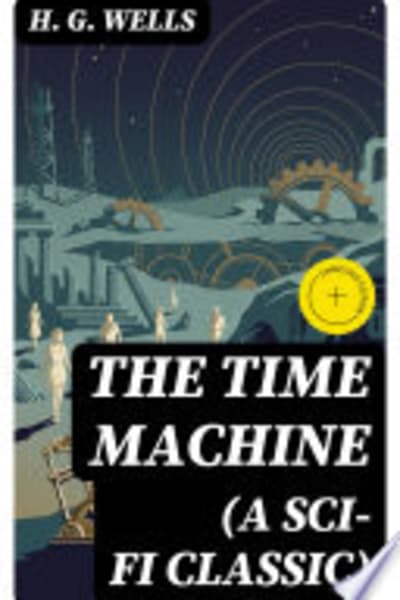
The Time Machine — Book Summary & Review
by H. G. (Herbert George) Wells
Last updated:
Public domain via Project Gutenberg — free and legal.
The Time Machine Summary
In The Time Machine, Wells builds the whole story around the Time Traveller’s framework for “working backward” from physical principles, then tests it by landing in 802,701 and watching utopia curdle. The narrator hears the machine’s logic and the Traveler’s confidence, but the book’s real engine is what happens after: he arrives in a surface world of pale, childlike Eloi who seem harmless, almost curated for leisure. The Time Traveller’s first shock isn’t danger—it’s the mismatch between how the future should feel and how it actually functions, which is Wells’s point about comfort as a political arrangement.
As the Traveler explores, he discovers a second society underground: the Morlocks, laborers shaped by time, environment, and long-term neglect. Wells doesn’t treat this as a simple “good people vs bad people” twist; he makes the social math feel bleakly plausible. The Eloi may look like a paradise, but the Traveler’s observations keep turning into evidence that someone is paying the price for that ease. The climax of his investigation—where he finally connects the surface routine to the subterranean survival system—lands with the force of a scientific hypothesis failing upward: the future is “explained,” and that explanation is worse than mystery.
Wells’s limitation is also part of the bargain: the novel is short, so the science and the ecology of the future are sketched, not fully developed. If you want sustained character depth, or a meticulously reasoned timeline, Wells’s arguments can feel more like social satire than a fully engineered future history. Still, The Time Machine is one of those rare classics where the structure itself—lecture, travel, observation, reversal—keeps pushing you to ask who benefits from your version of peace.
Key Takeaways from The Time Machine
-
1
Time Traveller’s “working backward” method: Wells frames time travel as a physics problem, then uses it to stress-test social assumptions.
-
2
802,701 as a constructed experiment: the distant date functions like a control group for how comfort can mask exploitation and class design.
-
3
Eloi vs Morlocks: Wells uses surface leisure and subterranean labor to show how inequality evolves when institutions stop checking power.
-
4
Subterranean class revelation: the Traveler’s gradual proof reframes “utopia” as a maintenance system with hidden costs.
-
5
Capitalist society commentary: Wells treats economic incentives as evolutionary forces, shaping bodies, habits, and even what people remember.
Who Should Read This
Someone who keeps wondering why “nice” societies can still run on cruelty will feel the book’s pressure right away. If you’ve just finished a modern dystopia and want the earliest version of that logic—told with a scientist’s curiosity—you’ll likely enjoy it.
Who Shouldn't Read This
If you need rich, emotionally complex characters and long-form worldbuilding, The Time Machine will feel frustratingly sketchy. If you want rigorous, internally consistent time-travel mechanics, Wells’s speculative leaps will annoy you.
Editor's Verdict
The single best thing Wells does is turn the Traveler’s observations into an escalating social hypothesis, culminating in his discovery of the Eloi/Morlock arrangement in the future. The real limitation is that the story stays in outline form, so neither the science nor the future’s ecology gets the sustained explanation some readers crave. If you’re the type who reads to trace how power hides behind “normal life,” this hits hardest during that middle stretch of exploration when your trust in the surface world starts to fail.
Ready to read The Time Machine?
Get your copy on Amazon today.
The Time Machine — Frequently Asked Questions
About H. G. (Herbert George) Wells
H. G. (Herbert George) Wells (1866–1946) was an English writer and social commentator. Born in Bromley, Kent, he was educated at the Normal School of Science and worked as a teacher before becoming a full-time author. He is credible on speculative time travel because he wrote The Time Machine (1895), a foundational work of science fiction grounded in late-19th-century scientific and philosophical debates. Other notable works include The War of the Worlds and The Invisible Man.