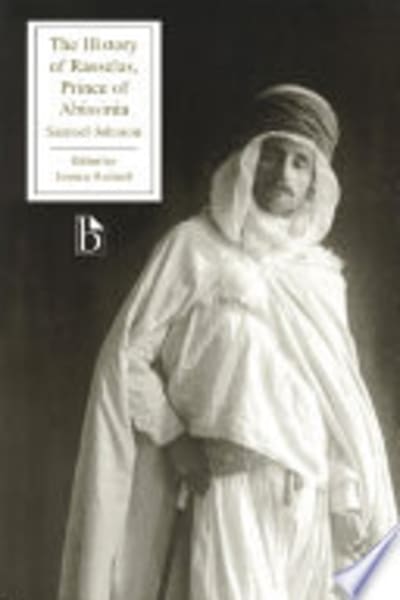
Rasselas, Prince of Abyssinia — Book Summary & Review
Last updated:
Public domain via Project Gutenberg — free and legal.
Rasselas, Prince of Abyssinia Summary
Rasselas, Prince of Abyssinia is built around a series of “happiness” experiments, where Rasselas and his tutor move from place to place trying to locate a stable answer to the question of what makes people content. Early on, Samuel Johnson sets the frame: the young prince is restless, his teacher is older and skeptical, and each new setting—court, wilderness, philosophy salons—gets weighed like evidence. One of the clearest structural moments comes when they discuss the limits of theoretical happiness: Johnson keeps returning to the idea that a person can’t simply swap environments and expect their inner machinery to change. When Rasselas asks for guidance, the tutor answers with arguments rather than comfort, and Johnson uses those conversations to satirize the polished philosophical tales that were popular in the mid-1700s.
A concrete example: the book’s famous detours through different social lives function like a checklist that never completes. Johnson’s method is to let each “solution” collapse under the weight of ordinary human contradiction—status brings envy, solitude brings boredom, learning brings anxiety about the world. Even when characters offer reasons they should be happy, Johnson shows how quickly those reasons rot into exceptions. If you come for the Voltaire-style momentum of Rasselas’s travel, you’ll feel the gears shift: Johnson wants you to notice how every proposed philosophy quietly dodges the mess of daily life.
Still, Johnson’s limitation is real: Rasselas doesn’t deliver a new, workable happiness theory of its own. It’s more interested in puncturing systems than building alternatives, so readers who want a satisfying doctrine or a character arc that “solves” contentment will feel stalled. By the end, the satire lands, but the destination is basically the awareness that the search itself is the trap.
Enjoyed this one? Read these next.
Top picks in Manners And Customs, chosen for readers of Rasselas, Prince of Abyssinia.

Heat and Dust
by Ruth Prawer Jhabvala
Check price on Amazon
Collected Stories
by Katherine Anne Porter
Check price on Amazon
The Collected Stories
by Jean Stafford
Check price on Amazon
The Stories of John Cheever
by John Cheever
Check price on AmazonKey Takeaways from Rasselas, Prince of Abyssinia
-
1
Happiness experiments: Rasselas and his tutor test happiness by switching settings, only to show each “cure” has hidden side effects.
-
2
The tutor’s skepticism: Johnson uses the older teacher to treat philosophy like a claim that must survive messy human behavior, not elegant logic.
-
3
Satire of philosophical tales: Rasselas mocks the era’s tidy moral fables by letting every neat conclusion fracture into exceptions.
-
4
Social status as a trap: Court life is portrayed as a treadmill of envy and insecurity, undermining the idea that rank guarantees contentment.
-
5
The book’s negative method: Johnson rarely offers a replacement philosophy; it trains you to distrust the promises of any system.
Who Should Read This
Someone who keeps buying books promising a philosophy of happiness and then feeling disappointed by how little changes in real life will get a lot out of Rasselas. If you’re stuck in the “maybe the next environment will fix me” loop—job, relationship, city—Johnson’s skepticism hits hardest.
Who Shouldn't Read This
If you want a plot that escalates toward a clear solution, Rasselas will frustrate you: it’s structured as argument and counterexample more than forward motion. If you dislike 18th-century moralizing prose and long philosophical conversations, Samuel Johnson’s style will feel slow and preachy rather than witty.
Editor's Verdict
The best thing Samuel Johnson does in Rasselas is sustain the happiness-question as a testable claim, not a slogan—scene after scene shows why each “answer” collapses under ordinary contradictions. The real limitation is that Johnson refuses to offer a constructive alternative philosophy, leaving you with critique more than guidance. Anyone who’s mid-life and tired of grand systems will feel it most when the book’s detours make you recognize your own hope that a new setting can fix inner dissatisfaction.
Ready to read Rasselas, Prince of Abyssinia?
Get your copy on Amazon today.
Rasselas, Prince of Abyssinia — Frequently Asked Questions
About Samuel Johnson
Samuel Johnson (1709–1784) was an English writer, critic, and moral essayist. He was educated at Pembroke College, Oxford, and developed a reputation through journalism and literary criticism, including his influential Dictionary of the English Language. Johnson wrote Rasselas, Prince of Abyssinia (1759), a philosophical tale drawing on his broad knowledge of theology, philosophy, and contemporary debates about happiness and human nature. Other notable works include The History of Rasselas, Prince of Abyssinia and Lives of the Most Eminent English Poets.