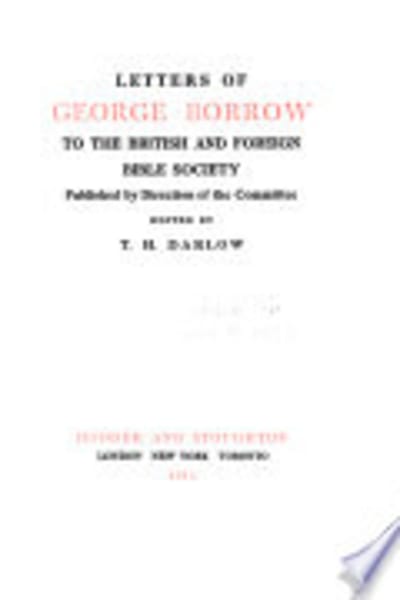
Letters of George Borrow to the British and Foreign Bible Society — Book Summary & Review
Last updated:
Public domain via Project Gutenberg — free and legal.
Letters of George Borrow to the British and Foreign Bible Society Summary
Letters of George Borrow to the British and Foreign Bible Society is built around Borrow’s recurring “Bible Society” correspondence—letters that pivot between practical fundraising notes, theological arguments, and his blunt reactions to how the Society operates. Borrow’s voice is unmistakable: he writes like a man who thinks institutions move too slowly, then spends the rest of the page explaining what should be done instead. One concrete thread runs through his insistence on getting Scripture into contested linguistic spaces, where he treats translation work as urgent labor rather than polite charity. You can feel him pressing the Society to act with speed and nerve, not simply with respectability.
A specific section that matters is the early run of letters where Borrow lays out his view of distribution—who should receive Bibles, how they should be delivered, and why “mere approval” is worthless if the books never reach readers who can actually use them. He also keeps returning to his sense that the Society’s public posture can’t replace practical strategy; if the Society wants results, Borrow argues, it has to tolerate controversy and commit resources where others hesitate. His letters are full of names, places, and small operational frictions, and Borrow uses those details to make a bigger point: bureaucracy is the enemy of Scripture’s impact.
Still, Borrow’s letters are not a smooth, unified treatise. If you want a single, carefully organized argument with consistent conclusions, you’ll find yourself doing some sorting. Borrow’s limitations are also real: the book doesn’t give you much historical context about the Society’s internal debates, so you may feel like you’re reading a running commentary without the full backstage story. If you came for polished fiction, Borrow’s “letters” will feel like stubborn, opinionated correspondence—often fascinating, occasionally exhausting.
Enjoyed this one? Read these next.
Top picks in English Authors, chosen for readers of Letters of George Borrow to the British and Foreign Bible Society.

The Love Letters of Mary Wollstonecraft to Gilbert Imlay
by Mary Wollstonecraft
Check price on Amazon
Emily Brontë
by A. Mary F. (Agnes Mary Frances) Robinson
Check price on Amazon
Maria; Or, The Wrongs of Woman
by Mary Wollstonecraft
Check price on Amazon
The Romany Rye
by George Borrow
Check price on AmazonKey Takeaways from Letters of George Borrow to the British and Foreign Bible Society
-
1
Bible Society correspondence: Borrow’s letters mix logistics, persuasion, and theology, showing how he links funding and distribution to spiritual outcomes.
-
2
Translation urgency: Borrow treats translation as time-sensitive work, arguing that delay turns goodwill into wasted effort.
-
3
Distribution strategy: He emphasizes who receives Bibles and how, using operational details to judge the Society’s effectiveness.
-
4
Institutional friction: Borrow repeatedly attacks slow decision-making, framing bureaucracy as an obstacle to real-world impact.
-
5
Borrow’s blunt tone: His candor isn’t decorative; it’s a method for forcing action, even when it risks offending recipients.
Who Should Read This
Someone who has been frustrated watching good intentions stall in committees will appreciate how Borrow turns the Bible Society’s work into a practical test. If you’re dealing with a stalled project—funding, outreach, or public communication—and need an argument for speed plus strategy, Borrow’s letters will land hard.
Who Shouldn't Read This
If you want a fictional narrative or a clean, continuous storyline, this correspondence will feel like scattered pressure rather than plot. If you dislike abrasive, highly opinionated nonfiction voice, Borrow’s relentless insistence on action will likely grate after the first few letters.
Editor's Verdict
The best thing Letters of George Borrow to the British and Foreign Bible Society does is show Borrow’s operational thinking in the “distribution” letters, where he argues that Scripture’s value depends on delivery to real readers. The real limitation is that the book gives too little context about the Society’s internal decision-making, so you’re left guessing how much he influenced outcomes. Anyone reading during a mid-project slump—when you’re tempted to wait for permission or consensus—will feel Borrow’s pressure most sharply.
Ready to read Letters of George Borrow to the British and Foreign Bible Society?
Get your copy on Amazon today.
Letters of George Borrow to the British and Foreign Bible Society — Frequently Asked Questions
About George Borrow
George Borrow (1803–1881) was an English writer, traveler, and translator. Born in England to a family of modest means, he became known for extensive journeys and for learning foreign languages, which enabled him to engage directly with Bible distribution efforts abroad. He is credible on this topic because his letters to the British and Foreign Bible Society document his firsthand observations of Bible work and his own involvement in related activities. Other notable works include The Bible in Spain and Lavengro.