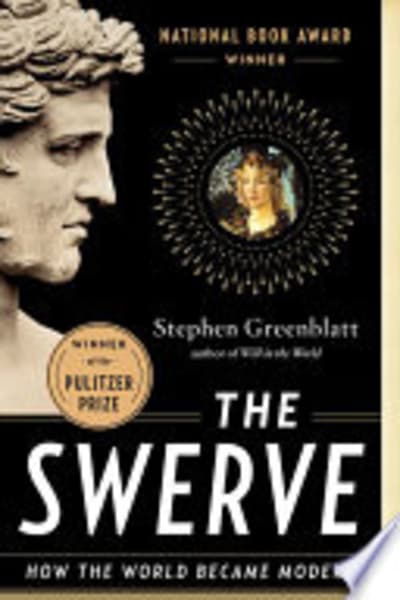
The Swerve — Book Summary & Review
Last updated:
The Swerve Summary
Stephen Greenblatt opens The Swerve with a vivid premise: he follows a single surviving manuscript—Lucretius’s On the Nature of Things—through the wreckage of time, then argues that its physical rescue helped rewire Europe’s intellectual habits. Greenblatt’s through-line is concrete and oddly suspenseful: a late-medieval copyist orders copies after recognizing the poem’s daring claims about a godless universe, religious fear as poison, and matter made of tiny particles in endless motion. He doesn’t treat this as abstract “influence”; he tracks how the copied text moves into translation, commentary, and artistic imagination, and he keeps returning to the same problem: how does a culture absorb ideas that threaten its moral and theological scaffolding?
A key section, “The Swerve,” uses Lucretius’s physics—atoms colliding and “swerve”-ing without divine steering—as a model for thinking: reality becomes intelligible without providence, and the mind learns to accept contingency. Greenblatt then stages the Renaissance as a set of reactions to that model. He links the poem’s rediscovery to figures like Botticelli and Giordano Bruno, and he shows why later scientists and writers could borrow the poem’s permission to doubt. When he reaches Shakespeare and Montaigne, the argument tightens: the text didn’t merely inspire themes; it normalized a way of handling uncertainty.
Limitation: The Swerve is heavy on Greenblatt’s narrative reconstruction and lighter on technical science; if you want rigorous atomism, or a tidy timeline with exhaustive archival proof, you’ll feel the scaffolding more than the bricks. Greenblatt also assumes patience for long detours into Renaissance culture, which can test your attention.
Key Takeaways from The Swerve
-
1
On the Nature of Things: Greenblatt treats Lucretius’s poem as a dangerous system, not a literary artifact.
-
2
The “swerve”: He uses atom-collision randomness to argue that thinking without divine control spreads through culture.
-
3
Manuscript recovery: The book’s engine is a single text’s survival and copying, which Greenblatt frames as intellectual infrastructure.
-
4
Religious fear critique: Greenblatt highlights Lucretius’s claim that dread damages health and judgment, reshaping moral reasoning.
-
5
Renaissance influence chain: Greenblatt maps how translation and imitation turn one manuscript into habits of doubt and observation.
Who Should Read This
If you’re stuck in the rut of reading history as disconnected events, someone who wants a single mechanism—one manuscript—connecting Renaissance art and modern science should read The Swerve. If you’ve ever wondered why “ideas” spread faster than institutions, Greenblatt’s text gives you a concrete, traceable route to follow.
Who Shouldn't Read This
If you want a strictly academic, evidence-maximized study with minimal storytelling, you’ll find Greenblatt’s narrative reconstruction too speculative and sometimes theatrical. If you’re mainly here for Renaissance politics or purely for scientific explanation, the long detours into literature and philosophy will feel like padding.
Editor's Verdict
The single best thing Greenblatt does is make “The Swerve” feel like an intellectual event by tying Lucretius’s atomism to how later writers learned to tolerate uncertainty. The real limitation is that Greenblatt often substitutes persuasive narrative for the kind of archival certainty a skeptic will demand. This hits hardest for anyone who’s mid-career questioning why their worldview keeps defaulting to inherited answers and wants a historical reason to keep doubting them.
Ready to read The Swerve?
Get your copy on Amazon today.
The Swerve — Frequently Asked Questions
About Stephen Greenblatt
Stephen Greenblatt (born 1943) is an American literary scholar and professor at Harvard University. He specializes in Renaissance literature and culture, with a focus on how classical texts and ideas shaped early modern Europe. His expertise and extensive research on the transmission of ancient works make him credible on the historical and literary questions central to The Swerve. Other notable works include Renaissance Self-Fashioning and Will in the World.