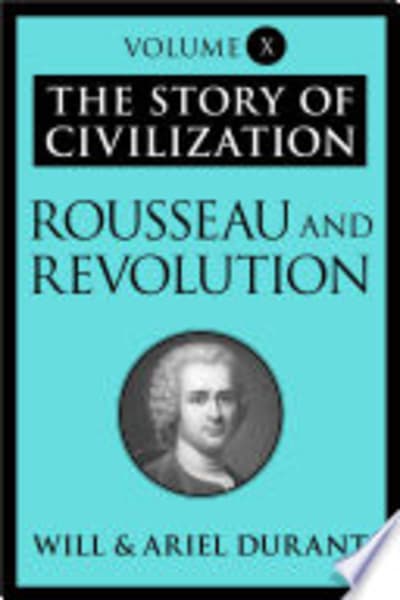
The Story of Civilization: Rousseau and Revolution — Book Summary & Review
by Ariel Durant and Will Durant
Last updated:
The Story of Civilization: Rousseau and Revolution Summary
In The Story of Civilization: Rousseau and Revolution, Ariel Durant organizes European history around a recurring claim: ideas about society don’t float above events—they get tested, distorted, and weaponized as governments and economies strain. The Durants start by moving through the eighteenth century’s intellectual weather, then braid it to the political weather: France’s crisis, England’s constitutional evolution, and Germany’s late-blooming cultural intensity, all feeding the revolutionary fuse. One of the book’s clearest structural moves is its attention to how Rousseau’s moral vocabulary—especially the Rousseau-style insistence that legitimacy must come from “the people”—turns into policy pressure once institutions can no longer absorb social anger.
Ariel Durant and Will Durant also keep returning to a practical historical method: treat philosophy as an engine with fuel sources (class conflict, religious authority, state finance), not as a set of abstract propositions. When their narrative reaches the revolution’s hardening phase, the authors don’t pretend the outcome was inevitable; they show how competing interests interpret the same language differently. Rousseau’s ideas become a banner for some, a nuisance for others, and a threat for nearly everyone in power, which is why the book is as much about translation failures as about “great thinkers.”
The authors’ strongest run is the way they connect Enlightenment debates to concrete breakdowns—bread-and-tax realities in France, institutional bargaining in England, and the cultural-political mismatch in much of German life leading up to 1789. Still, there’s a limitation: if you’re hunting for a tight, chapter-by-chapter argument about one revolution or one philosopher, this book will feel sprawling, sometimes more atmospheric than analytical.
Key Takeaways from The Story of Civilization: Rousseau and Revolution
-
1
Rousseau’s legitimacy problem frames politics as a question of who authorizes power, not merely how leaders govern.
-
2
Enlightenment vocabulary acts like political technology, with different social groups using the same ideas for opposite goals.
-
3
State finance and class tension are treated as the real accelerants, turning moral language into immediate pressure.
-
4
England’s constitutional evolution functions as a counter-model, showing how institutions can absorb conflict without total rupture.
-
5
European cultural timing matters, since Germany’s intellectual momentum doesn’t always line up with political readiness.
Who Should Read This
If you’re trying to understand why eighteenth-century ideas became revolutionary fuel instead of staying in salons, this book will match your question. Someone who feels history is “too abstract” and wants concrete links between beliefs, money, and institutions will likely enjoy the Durants’ approach.
Who Shouldn't Read This
If you want a narrow, fast, single-author argument with heavy footnotes and methodological transparency, you’ll find the narrative sweep frustrating. If you dislike long historical overviews that prioritize connections over exhaustive detail, you’ll probably feel restless halfway through.
Editor's Verdict
The single best thing the book does is connect Rousseau-centered moral legitimacy to the practical mechanics of crisis—showing how legitimacy talk becomes policy pressure when institutions fail, especially as the road to 1789 tightens. The real limitation is its breadth: it covers wide regions and long stretches, so it sometimes trades analytical precision for narrative atmosphere. This hits hardest for anyone who’s just finished a lightweight “ideas-only” history and wants to see how economics and institutions drag philosophy into blood-and-tax reality.
Ready to read The Story of Civilization: Rousseau and Revolution?
Get your copy on Amazon today.
The Story of Civilization: Rousseau and Revolution — Frequently Asked Questions
About Ariel Durant and Will Durant
Ariel Durant (1898–1981) was an American writer and editor who worked closely with her husband, historian Will Durant, on The Story of Civilization series. Will Durant (1885–1981) was an American historian and philosopher, trained in philosophy and known for synthesizing political, cultural, and intellectual history. Their credibility comes from decades of research and authorship of the multi-volume series. Other notable works include The Age of Reason (1929) and The Lessons of History (1968).