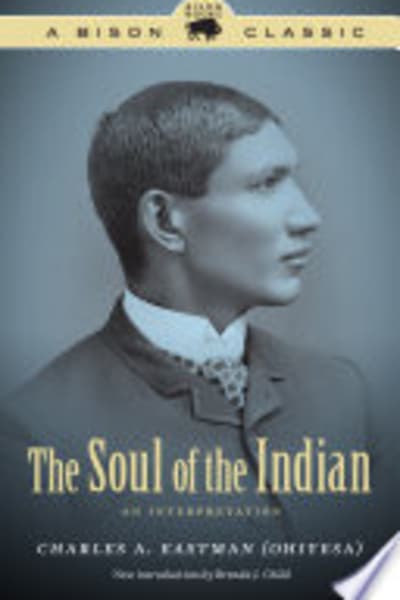
The Soul of the Indian: An Interpretation — Book Summary & Review
Last updated:
Public domain via Project Gutenberg — free and legal.
The Soul of the Indian: An Interpretation Summary
In The Soul of the Indian, Charles A. Eastman builds a clear framework for interpreting Dakota religion by treating it as lived relationship—between people, animals, plants, and place—rather than as “curiosity” for outsiders to collect. Eastman doesn’t wander through vague spirituality; he documents what he remembers, what he was taught, and what outsiders consistently misunderstood, then argues that outsider research often freezes living belief into museum pieces. Early in the book, Eastman leans on childhood instruction and ancestral ideals to show how religious practice is braided into daily ethics: how you speak to the land, what you owe to nonhuman life, and why reverence is practical, not decorative. He also keeps returning to the idea that Dakota spirituality has a universal personal appeal, which is his way of correcting the implied hierarchy in non-Native scholarship.
One concrete example of Eastman’s method is his attention to how stories and ceremonial attitudes shape conduct—he writes as if you can’t separate “religion” from the responsibility of staying in right relation with the natural world. He’s especially sharp on how environmental reverence isn’t sentimental; it’s a governing principle that organizes behavior and community memory. Eastman’s respect is constant, but his critique is also constant: he names the problem with outsiders treating the Dakota past as an object, not a worldview.
Limitation: this book is not a modern academic survey with footnotes, competing theories, or a systematic chapter-by-chapter taxonomy of all Dakota religious practices. If you want a comprehensive ethnography or a contemporary debate format, Eastman may feel more like a principled interpretation than a reference work.
Key Takeaways from The Soul of the Indian: An Interpretation
-
1
Dakota religious heritage as lived practice means belief shows up in conduct—how you treat animals, plants, and the land.
-
2
Outsider research critique frames non-Native writing as freezing living worldviews into curiosity, not understanding.
-
3
Childhood teaching functionally serves as evidence, since Eastman treats memory and instruction as legitimate sources.
-
4
Universal personal appeal is Eastman’s bridge: he argues Dakota spirituality speaks to anyone who values relational ethics.
-
5
Reverence for the environment operates as a governance system, not a mood, shaping community responsibilities.
Who Should Read This
Someone who feels spiritual language has gotten slippery—too abstract, too disconnected from daily ethics—will find Eastman grounding. If you’re trying to understand Native spirituality without turning it into either trivia or a political slogan, Eastman gives you a respectful starting point.
Who Shouldn't Read This
If you want a comprehensive, academically structured account of every Dakota ceremony and belief category, this book will frustrate you with its interpretive focus. If you prefer contemporary scholarship’s debate format and citation-heavy argumentation, Eastman’s early-1900s voice will feel limited and uneven in scope.
Editor's Verdict
The single best thing Eastman does is argue, through his critique of outsider framing, that Dakota religion must be read as a relational way of life—especially when he ties reverence to environmental responsibility. The limitation is that he offers interpretation and documentation from memory and teaching, not a systematic, exhaustive survey of all Dakota religious practices. This will hit hardest for anyone mid-career who’s tired of shallow spiritual talk and wants a grounded, respectful model of how belief regulates how you live.
Ready to read The Soul of the Indian: An Interpretation?
Get your copy on Amazon today.
The Soul of the Indian: An Interpretation — Frequently Asked Questions
About Charles A. Eastman
Charles A. Eastman (1858–1939) was a Santee Dakota physician, writer, and lecturer who was born in the Dakota Sioux and later educated in the United States and Europe, graduating from medical school in 1887. He worked as a doctor for Native communities and drew on his firsthand Dakota experience and extensive study to interpret Indigenous spiritual life for non-Native readers. He is credible because he combined lived knowledge with professional training. Other notable works include From the Deep Woods to Civilization and Indian Heroes and Great Chieftains.