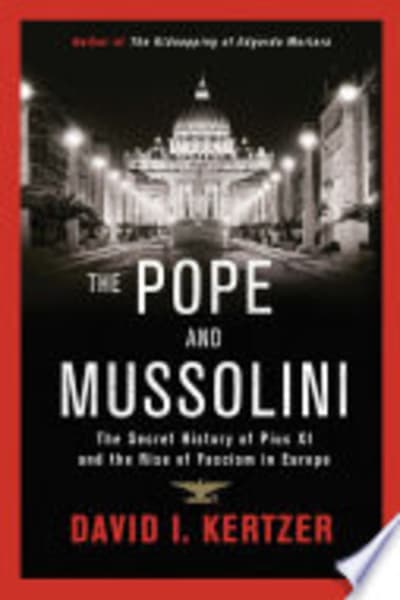
The Pope and Mussolini — Book Summary & Review
Last updated:
The Pope and Mussolini Summary
David I. Kertzer structures The Pope and Mussolini around a paper trail: Vatican maneuvering, Fascist intelligence reports, and Pius XI’s private anger as the Church traded moral authority for political leverage. Kertzer’s core claim is blunt—Pius XI helped make Mussolini’s dictatorship possible and helped keep it standing, not by “resisting” it but by negotiating with it from inside the machinery of power. A recurring device is Kertzer’s use of archival testimony attributed to intermediaries like Father Pietro Tacchi Venturi, who served as a kind of Vatican backchannel to “Il Duce,” including the ugly anti-Semitic assumptions that aligned Church officials with Fascist propaganda. One of the most concrete sequences comes in the book’s extended coverage of the 1922–1929 bargain: Mussolini restores privileges the Church had lost, police pressure Catholic morality, and the Vatican gains breathing room to crush rivals and secure influence.
Then Kertzer tightens the screws. As Hitler’s shadow lengthens, Pius XI’s confidence in the arrangement starts to curdle, and Kertzer portrays the pope’s threats to denounce Mussolini’s anti-Semitic racial laws as the moment the alliance begins to rot from the inside. The Vatican’s inner circle—especially Eugenio Pacelli, later Pius XII—tries to restrain Pius XI, because the partnership has become too useful to burn. Kertzer also spends real time on the king, Victor Emmanuel III, and makes the case that institutional weakness at the top helped Fascism harden.
Limitation: the book is less interested in the broader economic mechanics of Fascism than in Church-state diplomacy, so if you want an economics-first account of how dictatorships rise, you’ll feel the tilt toward ecclesiastical politics.
Key Takeaways from The Pope and Mussolini
-
1
Pius XI’s “secret relations” means quiet Vatican diplomacy—meetings, emissaries, and backchannel pressure—used to stabilize Mussolini’s rule.
-
2
Tacchi Venturi’s role shows how personal intermediaries functioned like political operators, carrying messages while laundering ideology through Church authority.
-
3
Pacelli’s Vatican power politics frames Eugenio Pacelli as a strategist who learned how to align with regimes without letting them dictate doctrine.
-
4
Fascist police enforcement of Catholic morality describes a practical exchange: dictatorship gets legitimacy, Church gets leverage over society.
-
5
Pius XI’s threatened denunciation of racial laws marks the breaking point where alliance math clashes with conscience and institutional survival.
Who Should Read This
If you’re trying to understand how authoritarian regimes win legitimacy through institutions that claim moral authority, this will land hard. Someone who already knows the broad story of Mussolini and wants the Vatican’s behind-the-scenes role will get what they’re looking for.
Who Shouldn't Read This
If you want a fast, narrative thriller with minimal names and documents, Kertzer’s archival density will feel like homework. If you’re looking for a full explanation of Fascism’s economic and social machinery, the book’s focus on Church-state negotiation may frustrate you.
Editor's Verdict
Kertzer’s best work is showing how the Pius XI–Mussolini alliance operated as policy, not morality play, especially through the emissary network and the shifting Vatican stance as racial laws loom. The limitation is that the book prioritizes ecclesiastical diplomacy over the wider structural causes of Fascism, so it can feel lopsided if you came for economics or mass politics. This will hit hardest for anyone mid-career who’s spent years asking how “respectable” institutions collaborate with ugly power, and now wants the receipts.
Ready to read The Pope and Mussolini?
Get your copy on Amazon today.
The Pope and Mussolini — Frequently Asked Questions
About David I. Kertzer
David I. Kertzer is an American historian and professor at Brown University. He earned his PhD in anthropology from the University of Chicago and has written extensively on twentieth-century Italy, religion, and politics. He is credible on the relationship between the Vatican and fascism because his research draws on archival sources and he has long studied Italy’s political history. His notable works include The Kidnapping of Edgardo Mortara and The Popes Against the Jews.