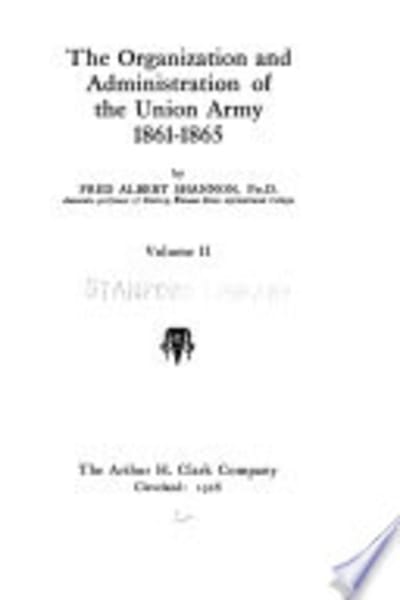
The Organization and Administration of the Union Army — Book Summary & Review
Last updated:
The Organization and Administration of the Union Army Summary
Shannon organizes The Organization and Administration of the Union Army around the practical machinery of command—how authority, paperwork, and manpower actually moved through the Union during 1861–1865. In the opening framework, Shannon treats “administration” as a system with choke points: recruiting, assigning, provisioning, and routing orders are all separate gears that can grind. One concrete example that keeps recurring is his attention to how enlistment and recruitment were handled through changing policies, then converted into usable units rather than staying as raw headcount. Shannon also spends real time on the Union’s personnel pipeline: who gets placed where, how replacement works after casualties, and how the army tries to keep formations coherent despite constant disruption.
A later focus—especially in the sections dealing with recruiting and the army’s internal organization—shows Shannon’s core argument: the Union’s success wasn’t only battlefield competence; it was the ability to build an organization that could absorb political pressure, state-level variation, and wartime improvisation. He keeps returning to the idea that administrative decisions have operational consequences, whether that means delays in filling ranks or mismatches between authority and responsibility. If you’re expecting a narrative of individual campaigns, Shannon will frustrate you; he’s more interested in the bureaucratic logic that makes campaigns possible.
The book’s limitation is real: it doesn’t give you much in the way of vivid storytelling or personal perspectives from common soldiers. It’s also not designed as a quick reference; the payoff comes when you stay with Shannon’s system-level explanations and keep tracking how one administrative change forces another. Shannon’s approach rewards readers who enjoy process—just don’t buy it hoping for drama.
Key Takeaways from The Organization and Administration of the Union Army
-
1
Union Army administration: Shannon treats bureaucracy as an operational engine, where orders, forms, and authority lines decide outcomes.
-
2
Recruiting and enlistment: He tracks how enlistment policies convert civilians into units, and how delays ripple into readiness.
-
3
Organizational authority: Shannon emphasizes mismatched responsibilities—when command structures don’t align, the army pays in confusion.
-
4
Personnel replacement: He explains how the army tries to keep formations functioning as casualties force constant reassignments.
-
5
War-time improvisation: Shannon argues the Union wins by adapting administrative routines to political and state-level variation.
Who Should Read This
Someone who’s frustrated by Civil War histories that focus only on generals and battles, and wants to understand how the Union actually staffed and ran armies. If you’re writing or studying a paper on Civil War institutions, and you need a system-level account of recruiting, command, and administration, Shannon is worth your attention.
Who Shouldn't Read This
If you want a soldier-centered narrative with vivid scenes and personality-driven storytelling, Shannon will feel cold and procedural. If you’re looking for a modern, fast-moving synthesis with clear chapter summaries and accessible “how-to” takeaways, Shannon’s 1928 approach will likely feel slow.
Editor's Verdict
The single best thing Shannon does is connect recruiting and administrative decisions to unit readiness, showing how authority and paperwork create real operational effects. The real limitation is that the book is organizational and bureaucratic first, with little human texture or battle narrative to keep you emotionally invested. This hits hardest for anyone mid-study or mid-career who’s realizing that “how armies work” matters more than the usual campaign timeline.
Ready to read The Organization and Administration of the Union Army?
Get your copy on Amazon today.
The Organization and Administration of the Union Army — Frequently Asked Questions
About Fred Albert Shannon
Fred Albert Shannon (1877–1963) was an American historian and educator who specialized in Civil War–era military organization and administration. He earned scholarly credibility through research and publication on Union Army structure, command, and bureaucratic practice. His expertise is reflected in his work The Organization and Administration of the Union Army. Other notable works include The Organization and Administration of the Union Army (and related studies on Civil War administration).