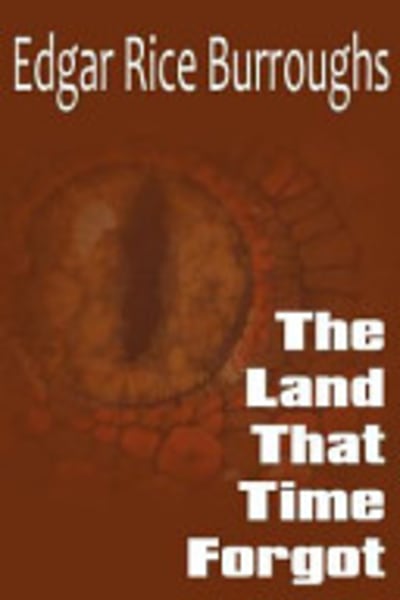
The Land That Time Forgot — Book Summary & Review
Last updated:
Public domain via Project Gutenberg — free and legal.
The Land That Time Forgot Summary
In The Land That Time Forgot, Edgar Rice Burroughs frames the whole ordeal as a dated first-person account—“the afternoon of June 3rd, 1916”—and uses that ticking clock to sell the feeling that the narrator has stumbled into a pocket of prehistory. The setup is brisk: a shipwreck, a rescue that turns into a march, and then the surreal discovery of a lost land where time behaves like a rumor. Burroughs isn’t subtle about what he wants you to picture: dinosaurs, primitive tribes, and a landscape that feels sealed off from the modern world by geology and fate.
Once the narrative locks onto the “lost pocket of the earth” idea, Burroughs leans hard into spectacle. You watch the narrator’s certainty get stripped away scene by scene—first by the sheer strangeness of what he sees, then by the social reality of surviving among people who have never heard of his century. The book’s momentum comes from repeated reversals: a plan works just long enough to lure the characters forward, and then the island corrects them. Burroughs also gives you concrete travel beats—crossing brutal terrain, negotiating with hostile groups, and trying to make sense of why the outside world can’t reach this place.
The limitation is real: this is not a mystery that “explains” itself with scientific rigor or moral complexity. Burroughs offers atmosphere and adventure, not careful anthropology, and the pacing can feel like it’s built from set pieces rather than character growth. If you want detailed world-building grounded in real paleontology or a nuanced view of the people on the island, Burroughs will frustrate you.
Still, Burroughs delivers exactly what his premise promises: an island where the past is alive, and the narrator’s fate is sealed long before he admits it. By the time Burroughs tightens the no-exit feeling of the opening framing, you understand why he’s treating this as a short, trapped interval rather than a long exploration.
Enjoyed this one? Read these next.
Top picks in Science Fiction, chosen for readers of The Land That Time Forgot.

Thuvia, maid of Mars
by Edgar Rice Burroughs
Check price on Amazon
The Lies of Locke Lamora
by Scott Lynch
Check price on Amazon
Independence Day
by Richard Ford
Check price on Amazon
God Emperor of Dune
by Frank Herbert
Check price on AmazonKey Takeaways from The Land That Time Forgot
-
1
June 3rd, 1916 narration: Burroughs anchors the story in a specific dated account to make the lost-world experience feel immediate.
-
2
“lost pocket of the earth” premise: The setting works like an isolated geological compartment, explaining why modern history can’t touch it.
-
3
Prehistory-as-survival: Dinosaurs and danger aren’t background texture; they drive decisions, alliances, and constant tactical readjustment.
-
4
Tribal encounter pattern: Burroughs structures conflict around negotiations with hostile groups rather than interior character psychology.
-
5
Time behaves like a rumor: The island’s continuity with deep history is presented as fact, not a question to solve.
Who Should Read This
Someone who craves old-school pulp adventure with dinosaurs and constant peril will likely have fun with Burroughs’s relentless set-piece structure. If you’re in the mood to read a short, high-concept lost-world story and don’t need it to be scientifically careful, Burroughs delivers.
Who Shouldn't Read This
If you want nuanced characterization and ethical depth, Burroughs’s island people largely function as obstacles, allies, or threats. If you expect an explanation-heavy mystery with airtight logic, this book’s premise stays atmospheric, not rigorous.
Editor's Verdict
The single best thing The Land That Time Forgot does is turn its dated June 3, 1916 framing into a pressure-cooker countdown, so every new sight feels like it’s happening inside a shrinking window. The real limitation is that Burroughs prioritizes adventure spectacle over anthropology, moral nuance, or scientific plausibility. This hits hardest for anyone who’s burned out on slow literary world-building and wants a short, chaotic lost-continent ride before bed.
Ready to read The Land That Time Forgot?
Get your copy on Amazon today.
The Land That Time Forgot — Frequently Asked Questions
About Edgar Rice Burroughs
Edgar Rice Burroughs (1875–1950) was an American writer and creator of adventure fiction. Born in Chicago, he worked various jobs before turning to writing in the early 1900s. He was credible for writing prehistoric-adventure stories because he published extensively in the genre and drew on contemporary popular interest in exploration and lost-world themes. He wrote The Land That Time Forgot (1918) and also authored Tarzan of the Apes (1912) and The Moon Maid (1926).