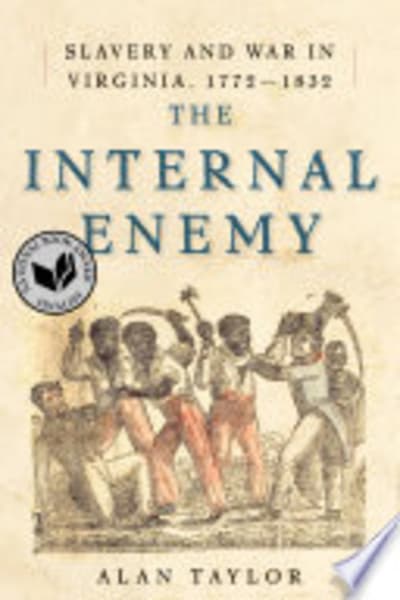
The Internal Enemy — Book Summary & Review
by Alan Taylor
Last updated:
The Internal Enemy Summary
In The Internal Enemy, Alan Taylor organizes the story around a single pressure point: enslaved people’s intimate knowledge of the countryside, which they use to shove British naval leadership toward liberation during wartime. Taylor’s structure is essentially a reconstruction—he threads together new sources and close readings of naval decision-making to show how “the internal enemy” wasn’t an abstract threat but a practical reality that demanded action. The book’s centerpiece is the network of coordination between enslaved communities and maritime forces, where routes, hiding places, and local terrain become strategic information rather than background color. Taylor keeps returning to the idea that the British response was shaped less by distant ideology than by what commanders could reliably anticipate on the ground.
One concrete example Taylor leans on is the way pressure accumulates through repeated uprisings and negotiations, forcing admirals to weigh whether holding enslaved populations meant losing control of the very theaters they were trying to secure. He also gives attention to the bureaucratic friction—dispatches, intelligence reports, and command rivalries—that turns moral choices into operational dilemmas. Taylor’s argument sharpens as he moves from the immediate events to the longer arc of how these interventions changed what liberation meant in practice: not as a slogan, but as a policy tool commanders could justify under pressure.
The limitation is clear: Taylor does not offer a sweeping social history of slavery across every colony, and if you came hoping for a broad cultural analysis of abolitionist thought, you may find the focus narrow and relentlessly tied to military and administrative mechanics. Still, for readers who want history that treats agency as intelligence and risk, Taylor’s The Internal Enemy delivers more than atmosphere—it supplies a tight causal chain built from documents.
Key Takeaways from The Internal Enemy
-
1
Internal Enemy framing: Taylor treats enslaved knowledge as a strategic force that shapes naval decisions, not mere atmosphere.
-
2
Countryside intelligence: Local terrain and routes function like operational data, influencing how commanders plan and justify liberation.
-
3
New-sources reconstruction: Taylor’s method relies on recently surfaced documents to correct or complicate familiar wartime narratives.
-
4
Admirals under pressure: Command choices are portrayed as risk management under constant threat from within the controlled space.
-
5
Liberation as policy mechanism: Freedom is shown as an actionable wartime tool, not a distant moral abstraction.
Who Should Read This
Someone who keeps getting frustrated by slavery history that centers only famous politicians will want Taylor’s focus on how enslaved people’s knowledge directly pressures British admirals. If you’re trying to understand how wartime decisions become moral outcomes through logistics and intelligence, this will land.
Who Shouldn't Read This
If you want a wide-ranging abolitionist intellectual history or a survey of slavery’s everyday life across multiple regions, Taylor’s scope will feel too tightly military. If you dislike document-heavy narrative that tracks command and dispatches, the emphasis on operational mechanics may test your patience.
Editor's Verdict
The single best thing this book does is its causal reconstruction of how enslaved people’s “internal enemy” pressure translated into specific shifts in British naval policy, with Taylor’s argument built around the operational consequences of intelligence. The real limitation is that Taylor stays locked to military administration and the decision chain, so readers seeking a broader cultural or economic history of slavery may feel underfed. This hits hardest for anyone who’s spent time on broad abolition books and now wants to see how liberation decisions get made inside the machinery of war.
Ready to read The Internal Enemy?
Get your copy on Amazon today.
The Internal Enemy — Frequently Asked Questions
About Alan Taylor
Alan Taylor is a historian and professor at the University of California, Davis. He is credible on the topic of the American Revolution and internal conflict because his scholarship focuses on the war’s social and political dynamics, including how communities, loyalties, and dissent shaped events. He has written extensively on early American history, including The Liberty Tree: Ordinary People and the American Revolution in Cambridge (2012) and William Cooper’s Town: Power and Persuasion on the Frontier of the Early American Republic (1995).