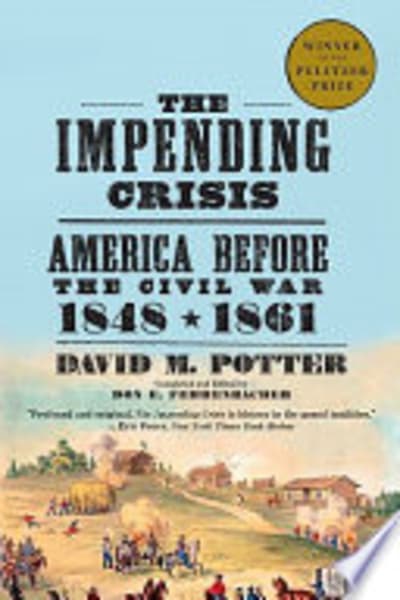
The Impending Crisis, 1848–1861 — Book Summary & Review
Last updated:
The Impending Crisis, 1848–1861 Summary
In The Impending Crisis, 1848–1861, David M. Potter organizes antebellum breakdown around a specific framework: the idea that multiple national stresses—economic change, territorial expansion, and political bargaining—kept colliding until “crisis” became the system’s default setting rather than a temporary emergency. Potter’s argument isn’t simply that slavery was the central problem; it’s that slavery acted like a solvent, dissolving compromise mechanisms across courts, parties, and public legitimacy. One of the book’s most useful moves is how Potter threads major flashpoints into a single political logic, especially around the Dred Scott decision and the way it narrowed room for incremental settlement. He also gives John Brown’s uprising more than moral symbolism; Potter treats it as a stress test that revealed how far the country had moved from shared rules of dispute.
Potter’s Lincoln material is where the book’s “sweeping epic” reputation earns its keep: he shows Lincoln ascending amid a landscape where earlier contending visions for the Union had already exhausted their credibility. The section on Southern succession reads like a culmination of the book’s earlier insistence that political institutions could not absorb the shock of sectional polarization. Potter’s prose can be dense, but the structure keeps paying off when you track how each event changes the incentives for the next.
Honest limitation: Potter does not write as a social-scientific analyst of everyday life; if you want vivid vignettes of enslaved people or ordinary voters, you’ll feel the book’s elite, institutional focus tighten its grip and sometimes leave you wanting more human texture than it offers.
Key Takeaways from The Impending Crisis, 1848–1861
-
1
Antebellum “crisis” framework: Potter treats crisis as an operating condition, not a single moment, produced by repeated institutional strain.
-
2
Slavery as solvent: slavery erodes compromise across parties, courts, and legitimacy, making moderation harder even when elites try it.
-
3
Dred Scott decision: Potter uses it to show how legal rulings narrowed political bargaining and inflamed sectional certainty.
-
4
John Brown’s uprising: Brown functions as a political stress test that exposes how fragile shared dispute rules had become.
-
5
Southern succession logic: Potter frames secession as an endpoint of exhausted legitimacy, not a sudden irrational rupture.
Who Should Read This
If you’re studying the Civil War era for a class, exam, or serious personal project and keep finding the same events explained in isolation, Potter gives you a connected political chain. Someone who wants to understand why compromise failed—through courts, parties, and legitimacy—will feel the payoff as Potter links the dots from 1848 onward.
Who Shouldn't Read This
If you want a narrative driven by charismatic characters and dramatic scenes, Potter will frustrate you with institutional, policy-heavy exposition. If your reading life is currently allergic to dense, argument-forward history, Potter’s pace and scope may feel like homework rather than entertainment.
Editor's Verdict
Potter’s best trick is his insistence that events like Dred Scott and John Brown fit a single political logic of collapsing compromise, which makes the arc from 1848 to succession feel inevitable rather than merely sequential. The limitation is that the book stays focused on elite institutions and national politics, not on everyday lived experience, so readers seeking social texture may leave dissatisfied. This book hits hardest for anyone mid-career who’s realized that “politics as usual” can run out of mechanisms long before people notice the system is failing.
Ready to read The Impending Crisis, 1848–1861?
Get your copy on Amazon today.
The Impending Crisis, 1848–1861 — Frequently Asked Questions
About David M. Potter
David M. Potter (1910–2001) was an American historian and professor of history at Princeton University. He specialized in U.S. political and constitutional development and the coming of the Civil War. Potter is credible on 1848–1861 because he produced major scholarship on nineteenth-century American political change, using extensive primary sources and rigorous historical analysis. His other notable works include The South and the Sectional Conflict (Vols. 1–2) and Lincoln and His Party in the Secession Crisis.