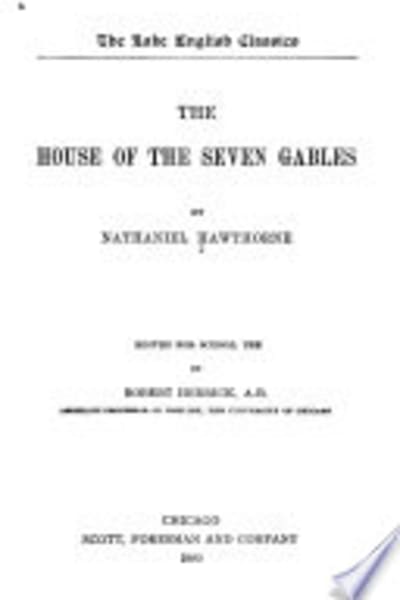
The House of the Seven Gables — Book Summary & Review
Last updated:
Public domain via Project Gutenberg — free and legal.
The House of the Seven Gables Summary
In The House of the Seven Gables, Hawthorne builds his “romance” out of a haunted house plot and a parallel moral argument about hereditary guilt, then keeps turning the screws by having the Pyncheon family’s past keep showing up in the present. The book is organized around the lingering curse of the Pyncheon line, where the narrator and events continually suggest that wrongdoing doesn’t evaporate—it mutates into habit, property, and self-justification. Hawthorne’s best move is how he makes symbolism feel like plot: the house itself is treated as a kind of memory that refuses to stay buried, and the characters keep behaving as if old sins are paperwork they can file away. You see this clearly in the recurring emphasis on documents hidden behind panels, which function like physical embodiments of conscience. Hawthorne also sharpens the national angle by tying private wrongdoing to the older colonial story of land, power, and “justice” performed for convenience.
One concrete example: the novel’s obsession with the Pyncheon inheritance isn’t merely background drama; it’s the mechanism that forces each generation to reenact the same moral failure while insisting they’re being practical. Another: the spectral threat isn’t only literal ghost business—it’s the pressure of expectation, the way characters interpret fear as fate and then call it destiny. Hawthorne’s slow burn can feel stiff if you want pure suspense, but the payoff is that the curse becomes a system for explaining why people keep repeating themselves.
Still, Hawthorne doesn’t offer the kind of crisp, modern psychological realism some readers expect—expect more allegorical framing, more moral commentary, and more patience than “twist” mechanics.
Key Takeaways from The House of the Seven Gables
-
1
Pyncheon curse: A family “inheritance” that behaves like moral momentum, pushing later characters into repeating earlier harm.
-
2
Hawthorne’s “romance”: A hybrid form mixing gothic events, symbolism, and social history rather than strict realism.
-
3
Hidden panels and documents: Secrets that act like conscience in physical form, forcing characters to confront what they try to ignore.
-
4
Ancestral sin: The book treats guilt as structural—embedded in property, stories, and self-serving interpretations.
-
5
National guilt: Hawthorne links household wrongdoing to colonial power and “justice” that favors the powerful.
Who Should Read This
If you’re stuck in a cycle of blaming your past while still benefiting from it, this novel will feel uncomfortably accurate. Someone who wants gothic atmosphere with moral math—how history hardens into behavior—should pick it up even if they’re tired of modern thrillers.
Who Shouldn't Read This
If you need fast pacing and clean cause-and-effect, Hawthorne’s deliberate symbolic method will frustrate you. If you dislike moralizing narration and allegorical framing, The House of the Seven Gables will feel like it keeps stepping between you and the plot.
Editor's Verdict
The single best thing Hawthorne does is turn the house’s hidden-history machinery—those concealed documents and the Pyncheon obsession with inheritance—into a working model of guilt that drives scenes, not just themes. The real limitation is that the novel’s “romance” structure leans heavily on symbolism and commentary, so suspense and character psychology arrive slowly rather than sharply. This hits hardest for anyone who’s mid-career, watching a family legacy or institution reward them while quietly demanding their silence.
Ready to read The House of the Seven Gables?
Get your copy on Amazon today.
The House of the Seven Gables — Frequently Asked Questions
About Nathaniel Hawthorne
Nathaniel Hawthorne (1804–1864) was an American novelist and short story writer from Salem, Massachusetts, born to a family with deep New England roots. He drew on local history and Puritan-era themes, making him credible for works about colonial society and its legacies. Hawthorne published The House of the Seven Gables (1851), which examines inherited guilt and social change. Other notable works include The Scarlet Letter (1850) and Twice-Told Tales (1837).