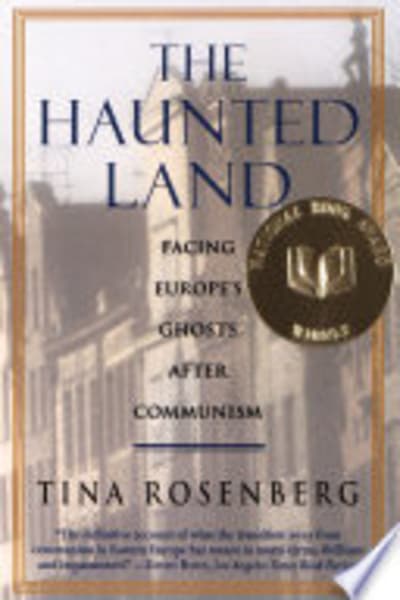
The Haunted Land — Book Summary & Review
Last updated:
The Haunted Land Summary
In The Haunted Land, Tina Rosenberg organizes her reporting around the moral whiplash of four new democracies—Germany, Poland, the Czech Republic, and Slovakia—facing what she treats as a single, recurring problem: how to live with the past without rewriting it into a comforting present. Rosenberg keeps returning to a framework she calls the “memory temptation,” where the old regime’s crimes are replaced by a new political orthodoxy that quietly edits who is to blame. She repeatedly shows that atonement is not a courtroom event; it’s an everyday negotiation, from party meetings to kitchen-table conversations, where people weigh whether truth is revenge or repair. A concrete example Rosenberg uses is the post-1989 reckoning with collaborators and informants, where the question “Who counts as guilty?” collides with the fact that many perpetrators were also spouses, friends, and fathers. Another recurring scene is the bureaucratic churn of archives and vetting, where officials insist they’re pursuing justice while privately managing reputational risk. Rosenberg’s most Kafka-like tension comes from the way legal reforms and public ceremonies can coexist with private denial, producing a society that loudly proclaims closure while privately hoarding uncertainty. Her reporting also stresses how the idealists of communism—people who thought they were building a better world—become part of the moral debris, and how that complicates simple villain stories. Rosenberg is best when she slows down to show how memory policy becomes family policy, and how public language (“justice,” “purification,” “reconciliation”) can hide ordinary self-interest. The limitation: the book won’t satisfy readers looking for a neat, universal theory of transitional justice; Rosenberg’s strength is case-based reporting, so the argument stays messy rather than systematized.
Key Takeaways from The Haunted Land
-
1
Memory Temptation: Rosenberg shows how new elites recast the communist past to justify today’s power, not simply to repair harm.
-
2
Archive Reckoning: The fight over files becomes a fight over identities, where paperwork decides whose story counts as truth.
-
3
Guilt as a Family Problem: Rosenberg frames guilt as intimate, since many informants were husbands, fathers, and best friends.
-
4
Legal Purification vs Private Denial: Court actions and public ceremonies can coexist with ongoing self-protection and selective remembering.
-
5
Idealist Complicity: Rosenberg insists wrongdoing often came from sincere believers, making moral accounting harder than “bad guys” narratives.
Who Should Read This
Someone who feels uneasy about how public memory gets managed—maybe after a recent political scandal or culture-war debate—will recognize Rosenberg’s pattern fast. If you’re wrestling with questions about justice versus forgiveness in your community or family, Rosenberg’s casework will land harder than abstract ethics.
Who Shouldn't Read This
If you want a clean, step-by-step guide to transitional justice, you’ll be frustrated: Rosenberg stays with journalism and moral mess, not a universal blueprint. If you dislike long, character-rich political reporting across multiple countries, the shifting settings and recurring dilemmas may feel repetitive.
Editor's Verdict
The single best thing The Haunted Land does is connect state-level reckoning to personal relationships, especially Rosenberg’s repeated focus on how collaboration questions explode inside families. The real limitation is that Rosenberg offers no unified theory or consistent policy prescription—her payoff is narrative moral accounting, not a tidy framework. This hits hardest for anyone mid-career who’s just realized their workplace or local politics runs on selective memory and convenient blame.
Ready to read The Haunted Land?
Get your copy on Amazon today.
The Haunted Land — Frequently Asked Questions
About Tina Rosenberg
Tina Rosenberg is an American journalist and author. She has reported extensively on politics, human rights, and social issues, with work appearing in major outlets such as The New York Times. Her reporting and research background—combined with on-the-ground coverage of conflict and its effects on civilians—makes her credible for writing about the aftermath of violence in The Haunted Land. Other notable books include Join the Club and The Man Who Loved China.