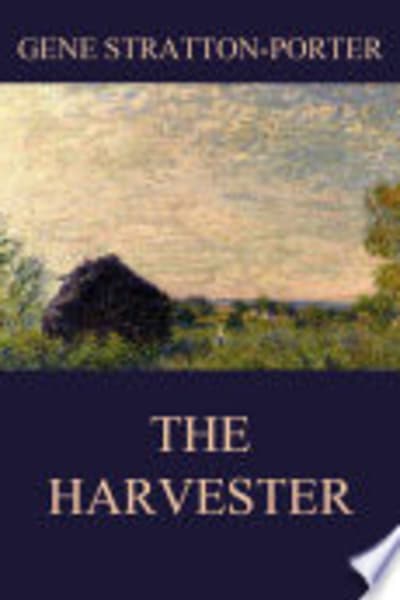
The Harvester — Book Summary & Review
Last updated:
Public domain via Project Gutenberg — free and legal.
The Harvester Summary
In The Harvester, Gene Stratton-Porter builds its romance around the contrast between David Langston’s “ideal” life in the woods and the very physical arrival of Ruth Jameson, and the book keeps returning to that collision. Langston—called “the Harvester” because he collects and sells medicinal herbs—lives like a reformer from the margins of history, convinced that nature can purify desire into something almost holy. Then Ruth appears in a way he can’t explain away: she’s the girl he’s been imagining, not a metaphor, but a person with needs, fears, and a stubborn reality that doesn’t care about his philosophy.
Stratton-Porter’s best scenes are the ones where Langston’s worldview strains under ordinary human friction: courting that feels like a sermon in one chapter, tenderness that turns clumsy in the next, and moral certainty that has to negotiate with Ruth’s own judgment. The book’s emotional engine isn’t plot twists so much as escalating sincerity—Langston’s commitment to “harvest” goodness from the land, and his insistence that love should be selfless, disciplined, and earned through action rather than talk. Ruth Jameson becomes the test case for whether an idealist can love without turning the beloved into a project.
One limitation: The Harvester leans hard into early-1900s Christian moral framing and nature-as-instruction, so readers who want sharp psychological realism or modern pacing may find the tone earnest, sometimes slow, and occasionally preachy. If you’re hunting for gritty realism or moral ambiguity, Stratton-Porter’s world will feel too tidy—especially when Langston’s feelings are treated like a virtue rather than something messy.
Key Takeaways from The Harvester
-
1
David Langston’s “harvest” ethic frames love as labor, not sentiment, with medicinal herbs standing in for discipline.
-
2
Ruth Jameson functions as a reality-check, forcing Langston’s imagination to face consent, boundaries, and plain human emotion.
-
3
Medicinal herb collecting is more than setting; it structures time, money worries, and how Langston proves devotion.
-
4
Christian moral duty shapes every romance beat, so affection is evaluated through behavior, not chemistry alone.
-
5
Stratton-Porter’s nature writing is instrumental, where landscapes teach values and feelings are repeatedly tied to seasons.
Who Should Read This
Someone who’s stuck in an “all feelings, no follow-through” routine and wants a story where love is tested by daily work and moral choices. If you like turn-of-the-century Indiana settings and don’t mind faith-forward narration, you’ll likely feel steadier after reading The Harvester.
Who Shouldn't Read This
If you need psychologically messy characters who doubt themselves in believable, modern ways, Stratton-Porter’s idealism may feel rigid and rehearsed. If you’re tired of Christian-coded romance where virtue is the main currency, The Harvester will likely irritate you more than it comforts you.
Editor's Verdict
The single best thing The Harvester does is make its romance hinge on the practical clash between Langston’s idealism and Ruth Jameson’s lived reality, with the herb-collecting routine grounding the love story. The real limitation is its heavy, consistently uplifting Christian moral tone that can flatten complexity and slow the emotional stakes. If you’re someone who reads for character ambiguity and sharp modern pacing, this book may hit hardest when you realize you won’t get the messiness you want—especially after Langston’s repeated certainty starts to feel like an argument.
Ready to read The Harvester?
Get your copy on Amazon today.
The Harvester — Frequently Asked Questions
About Gene Stratton-Porter
Gene Stratton-Porter (1863–1924) was an American naturalist, photographer, and writer. She grew up on an Indiana farm, later studying and observing local wildlife and plants extensively. Her credibility on rural life and nature comes from years of firsthand fieldwork and documentation, including photography and detailed natural history writing. She authored The Harvester (1911), and also wrote A Girl of the Limberlost (1909) and Freckles (1904).