The Growth of American Thought — Book Summary & Review
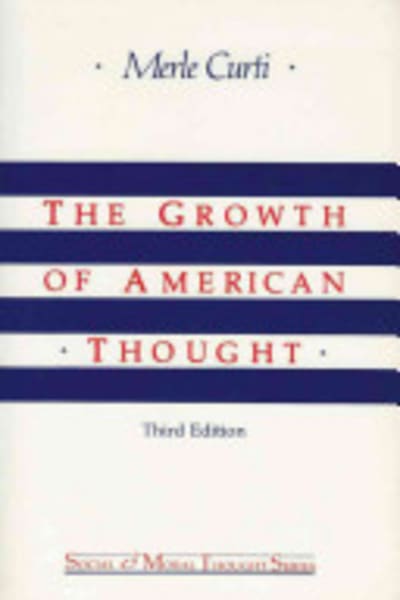
by Merle Curti
Last updated:
The Growth of American Thought Summary
Merle Curti’s The Growth of American Thought is built around a recurring framework: he treats ideas as social products, then tracks how institutions, conflicts, and everyday life shape “American thought” over time. The book’s core move is to refuse a purely literary or philosophical history; Curti keeps dragging intellectual claims back into the messy American milieu—schools, churches, reform movements, political debates, and class tensions—so that “ideas” behave more like weather systems than like isolated geniuses. One of the clearest demonstrations comes in his discussion of the rise of reform-minded intellectual life, where he links moral rhetoric to organizational change and public policy pressures rather than treating moral language as decorative. Curti also leans hard on his method of interrelationships: he’s interested in feedback loops (how new ways of thinking recruit supporters, and how supporters retool the institutions that produce the next wave of thinking).
A specific strength is how Curti handles the long arc from early national intellectual habits to later twentieth-century patterns, showing recurring tensions between cosmopolitan learning and local cultural needs. He’s particularly good at explaining why certain arguments gained traction: not because they were “truer,” but because they fit the social machinery that could carry them. Still, Curti’s ambition is also the book’s main drawback. He rarely slows down to give you tight, scene-by-scene biographies of the thinkers themselves, and the prose can feel like an extended argument you have to keep your place in. If you want a narrative driven by personalities or crisp, self-contained chapters, Curti will frustrate you. At nearly 939 pages, you’ll want patience and a tolerance for broad synthesis—Curti doesn’t offer a quick tour; he offers a working map, and it’s on you to read it like one.
Key Takeaways from The Growth of American Thought
-
1
Interrelationships: Curti connects thinkers’ ideas to institutions, politics, and reform networks so philosophy reads like social cause-and-effect.
-
2
Intellectual life as social history: He treats sermons, schooling, and civic debate as engines that manufacture and spread “thought.”
-
3
National experience framing: Curti organizes argument around what makes American patterns distinct, not just European influence and imitation.
-
4
Reform-minded intellectual life: He shows how moral rhetoric gains power by aligning with organizations and policy pressures.
-
5
Long arc synthesis: Curti tracks recurring tensions across eras, so arguments echo through decades instead of stopping at events.
Who Should Read This
Someone building a research project on American intellectual history and needing a model for linking ideas to institutions will benefit most. If you’ve been frustrated by books that treat “thought” as separate from churches, schools, and politics, Curti will feel like relief.
Who Shouldn't Read This
If you want a character-driven narrative that follows individual thinkers closely through dramatic scenes, Curti’s method will feel frustratingly abstract. If you dislike dense synthesis and long stretches of argument with few pauses, The Growth of American Thought will test your attention every chapter.
Editor's Verdict
The single best thing The Growth of American Thought does is insist on Curti’s interrelationships method, especially when he ties reform language to organizational and policy change rather than leaving it floating as pure ideas. The real limitation is that Curti gives you broad intellectual-social mapping more than close, personality-centered storytelling. This will hit hardest for anyone mid-career who keeps asking why their field’s “big ideas” change with institutions—right when you need a framework, not anecdotes.
Ready to read The Growth of American Thought?
Get your copy on Amazon today.
The Growth of American Thought — Frequently Asked Questions
About Merle Curti
Merle Eugene Curti (1907–1996) was an American historian and educator, trained at the University of Wisconsin and later a professor at the University of Wisconsin–Madison. He specialized in intellectual and social history of the United States. Curti is credible on American thought because he studied and wrote extensively about American intellectual and cultural development using scholarly historical methods. His notable works include The Roots of American Loyalty (1946) and The American Peace Crusade (1931).