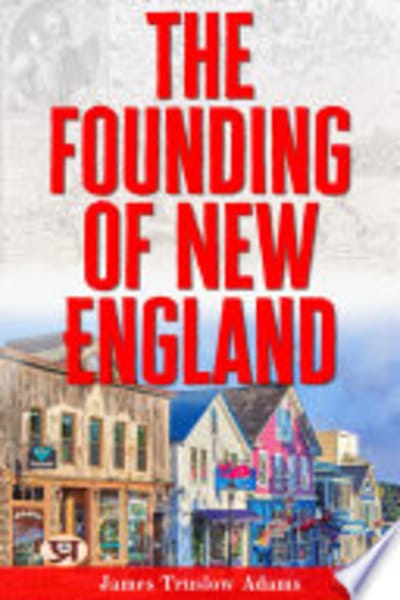
The Founding of New England — Book Summary & Review
Last updated:
The Founding of New England Summary
In The Founding of New England, James Truslow Adams organizes his argument around the region’s “social, political, and religious forces,” and he keeps returning to how those three currents collide in everyday colony life. Early on, Adams lays out a framework for understanding New England not as a single founding moment but as a sequence of settlements shaped by church discipline, local governance, and the economics of survival. One of his most useful concrete examples is his treatment of the Puritan impulse to build communities with enforced moral order—he doesn’t stop at slogans, instead showing how doctrine turns into institutions, from church membership norms to town-level authority.
Adams also leans hard into conflict as a formative engine. He repeatedly circles back to tensions between idealized covenant community and the messy reality of dissent, hierarchy, and competing interests. Even when he’s summarizing, he tends to anchor the story in specific flashpoints: disputes over authority, the friction between “godly” leadership and ordinary colonists, and the way external pressure (war, scarcity, imperial policy) forces internal decisions. In other words, Adams’s New England is built by people who believe they’re building something righteous, then must govern like bureaucrats when belief runs into human nature.
A limitation: this is a broad, narrative synthesis written in 1921, so it often reads less like a deep dive into one town or archive and more like a high-level overview that assumes you’re willing to accept his selected examples. If you want a modern scholarly apparatus, extensive footnoted debates, or a tight focus on one specific decade, Adams may frustrate you. Still, Truslow Adams’s clear through-lines make it easier to see how New England’s “founding” becomes a system that keeps reproducing itself long after the first arrivals.
Key Takeaways from The Founding of New England
-
1
Puritan “covenant” community: Adams treats covenant as a governing logic, turning religious promises into rules for membership and behavior.
-
2
Town-level authority: The book shows how local governance grows from church-centered social control, not from abstract political theory.
-
3
Religious discipline: Adams explains that discipline isn’t decoration; it shapes daily life, leadership legitimacy, and conflict resolution.
-
4
External pressure: War, scarcity, and imperial policy repeatedly force internal compromises, exposing the gap between ideals and practice.
-
5
Adams’s synthesis method: The narrative prioritizes patterns across settlements, so individual micro-histories matter less than recurring structures.
Who Should Read This
Someone who keeps bouncing between big-name colonial events and wants a clearer sense of how religion, politics, and community-building actually interlock should read Adams. If you’re trying to write or teach about early America and need a readable architecture for New England’s origins, this will help.
Who Shouldn't Read This
If you want modern-grade scholarship with heavy footnoting, historiographical sparring, and precise debates, Adams will feel dated and airy. If you only care about one narrow topic—say, a single colony’s economy or a single war—this broad synthesis will feel like it keeps stepping back.
Editor's Verdict
The single best thing The Founding of New England does is connect church discipline to concrete institutions, using Adams’s framework of social, political, and religious forces to explain how governance emerges. The real limitation is its preference for broad synthesis over deep archival specificity, meaning it can feel selective when you want granular detail. This hits hardest for anyone studying early American history for a class or presentation and needing a structured explanation before they start chasing primary sources.
Ready to read The Founding of New England?
Get your copy on Amazon today.
The Founding of New England — Frequently Asked Questions
About James Truslow Adams
James Truslow Adams (1878–1949) was an American historian and writer. He studied at Yale and worked as a journalist and editor before publishing historical scholarship. Adams is credible on early colonial history through his extensive research and writing on the English colonies, including The Founding of New England (1921), which examines the origins and development of New England. Other notable works include The March of Democracy (1931) and The Epic of America (1931).