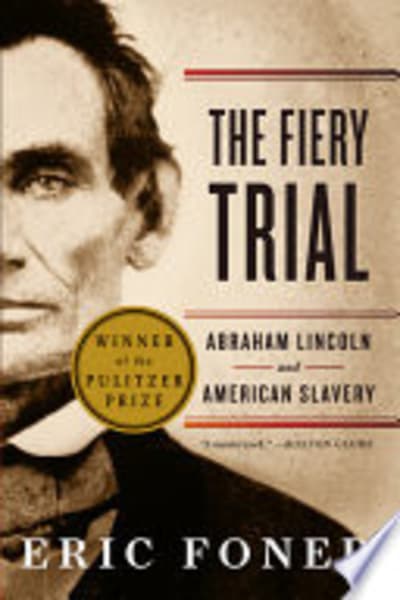
The Fiery Trial — Book Summary & Review
by Eric Foner
Last updated:
The Fiery Trial Summary
Eric Foner frames The Fiery Trial by pairing Abraham Lincoln’s own writings with brief introductions that track how his positions shifted from the 1830s through the Civil War, turning a stack of speeches and letters into a timeline you can argue with. The structure is the point: over one hundred documents, each preceded by context, so you can watch Lincoln’s language harden around slavery, union, and emancipation as politics and war pressure his choices. A concrete highlight is the way Foner sets up Lincoln’s early encounters with slavery while later selections land with the weight of 1862–1865 language, where “freedom” stops being a moral abstraction and becomes policy reasoning. Foner also makes you pay attention to Lincoln’s shifting stance on colonization and gradualism by placing adjacent documents close enough that you can see the rhetorical work being done.
Foner’s introductions don’t pretend the sources speak for themselves; he repeatedly signals what each document is trying to do—justify, reassure, recruit votes, or answer critics—so you read Lincoln as a politician with strategy, not a statue with one permanent doctrine. The book’s “fiery trial” is basically the Civil War years as a crucible for constitutional and political change, and Foner keeps returning to how Lincoln wrestles with authority: what the federal government can do, what it must do, and what it can’t do without breaking the union he’s trying to preserve.
A limitation: this is not a narrative biography, and it won’t give you a smooth, story-driven account of Lincoln’s life from start to finish. If you want one continuous storyline or a deep dive into a single theme (like the Gettysburg Address alone), the document hopping will feel fussy and occasionally repetitive.
Key Takeaways from The Fiery Trial
-
1
Lincoln’s 1832–1865 document sweep shows how his ideas mutate under party pressure and wartime necessity, not in a straight line.
-
2
Foner’s brief introductions teach you to read each speech or letter as a political move, with an audience and a goal.
-
3
Emancipation policy reasoning appears as argument work, where moral language and constitutional claims evolve together across selections.
-
4
Lincoln’s shifting views on slavery and colonization can be tracked by proximity of documents, making contradictions harder to hand-wave.
-
5
The Civil War “fiery trial” framing treats war as the engine of change, forcing Lincoln to redefine federal power.
Who Should Read This
Someone who is stuck in the “Lincoln = one message” trap—maybe after reading a few famous speeches and feeling confused—will get real mileage from Foner’s document-by-document structure. If you’re writing a paper or arguing with someone about when Lincoln “became” an emancipationist, this book gives you the primary-text scaffolding to be specific.
Who Shouldn't Read This
If you want a flowing biography with scenes and character development, you’ll be annoyed by the book’s constant switching among unrelated writings and the dependence on Foner’s short framing. If you dislike source collections with introductions—especially one that runs long and expects you to do some sorting yourself—The Fiery Trial will feel like homework rather than pleasure.
Editor's Verdict
The single best thing Foner does is use his document-and-introduction format to let you watch Lincoln’s political logic tighten over time, especially around emancipation and the constitutionally framed limits of action. The real limitation is that it’s a curated primary-source reader, not a narrative biography, so readers who want a continuous story will feel the seams. Anyone revisiting Lincoln after a debate—say, mid-career when you’re tired of vague claims about “Lincoln’s real beliefs”—will find the hardest moments land when the text contradicts the myth.
Ready to read The Fiery Trial?
Get your copy on Amazon today.
The Fiery Trial — Frequently Asked Questions
About Eric Foner
Eric Foner is an American historian and professor at Columbia University. He specializes in U.S. history, especially the Civil War, Reconstruction, and the history of political rights. He is credible on Reconstruction-era constitutional change and the era’s political conflicts, drawing on extensive scholarly research and publications. He is the author of The Fiery Trial: Abraham Lincoln and American Slavery and also wrote Give Me Liberty! An American History and Reconstruction: America’s Unfinished Revolution, 1863–1877.