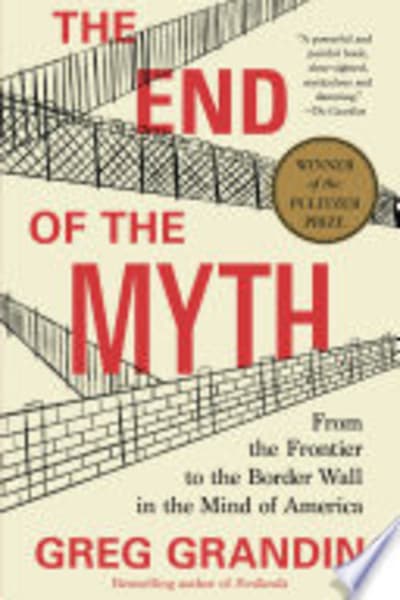
The End of the Myth — Book Summary & Review
by Greg Grandin
Last updated:
The End of the Myth Summary
Greg Grandin organizes The End of the Myth around what he calls a “gate of escape”: the long-running American habit of pushing conflict and blame outward—westward expansion, overseas wars, new markets—so domestic tensions could be postponed instead of confronted. Grandin’s sweep starts with the frontier thesis and the Revolution-to-Spanish-American-War arc, then keeps tightening the argument as he moves through the New Deal era and into the political symbolism of the border wall. The core claim is blunt: expansion wasn’t only economic or geographic; it was political anesthesia, a way to redirect anger away from racism, inequality, and class conflict. Grandin repeatedly returns to how “American exceptionalism” is manufactured through motion—move outward, call it progress, and treat the resulting violence as necessary growing pains.
One concrete example is his treatment of militarized expansion as a domestic pressure-release valve: when wars and territorial projects absorb resources and attention, the country can tell itself it’s solving problems “out there.” Another is his linking of the 2008 financial meltdown and the failures of recent wars to a home-front backlash that finally stops being deflected. By the time Grandin reaches the Trump years, the border wall becomes less a policy detail than an allegorical tombstone for the exceptionalist story, because it replaces the old promise of endless outward movement with a hard stop.
A limitation: this book is built for readers who want broad political history and theory at speed; it doesn’t slow down to offer a neat, evidence-by-evidence courtroom brief on every claim, and it can feel repetitive if you’ve already read a lot of frontier-thesis criticism.
Key Takeaways from The End of the Myth
-
1
Gate of escape: Grandin argues expansion lets the U.S. redirect internal conflict outward instead of addressing it at home.
-
2
Frontier thesis: He treats the classic expansion story as political machinery, not neutral background, shaping national self-images.
-
3
American exceptionalism: Grandin shows exceptionalism relies on motion and promise, then collapses when the outward option shuts.
-
4
Border wall symbolism: The wall functions as an allegorical end-point, signaling the death of the old expansion narrative.
-
5
Deflection through war and markets: Grandin links outward campaigns to domestic postponement of racism and inequality.
Who Should Read This
Someone who feels like today’s U.S. politics is stuck in anger without a shared explanation will get traction from Grandin’s gate-of-escape framing. If you’ve been trying to connect economic shocks and culture-war rage to deeper historical patterns, Grandin gives you a usable map.
Who Shouldn't Read This
If you want close-up storytelling or heavily documented, chapter-by-chapter case studies, you may find Grandin’s broad historical sweep frustratingly fast. If you already agree with the frontier-thesis critique and want fresh archival surprises rather than synthesis, The End of the Myth will likely feel like a re-argument.
Editor's Verdict
The single best thing Grandin does is connect the frontier thesis to modern backlash by treating the border wall as an endpoint to the “gate of escape,” not merely a campaign prop. The real limitation is that the argument is delivered as an ambitious, continuous synthesis with less granular proof than readers expect from a thick political-history audit. If you’re someone who keeps asking why outward promises still fuel domestic polarization—especially after a major economic downturn—this hits hardest right after you finish news cycles about immigration, war fatigue, and inequality.
Ready to read The End of the Myth?
Get your copy on Amazon today.
The End of the Myth — Frequently Asked Questions
About Greg Grandin
Greg Grandin is an American historian and writer. He teaches at New York University and has written widely on Latin America and U.S. foreign policy. He is credible on myths and political power because his scholarship examines how ideology shapes state action and historical narratives. Grandin’s books include The Empire of Necessity and The Blood of Guatemala. He also wrote The End of the Myth.