The Dred Scott Case — Book Summary & Review
Last updated:
The Dred Scott Case Summary
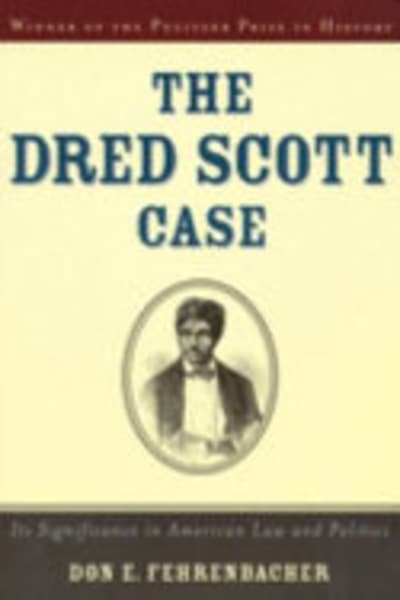
Fehrenbacher’s The Dred Scott Case is built around a forensic method: he keeps returning to how courts constructed “legal bases” for slavery, then shows how those bases collided with constitutional arguments and the political pressure of expansion. Early on, Fehrenbacher frames the case as more than a single decision; he treats it as a judicial failure where reasoning is shaped to reach a predetermined outcome. He spends serious time on the legal architecture behind slavery—especially the way property claims, status doctrine, and jurisdictional maneuvers get braided together—so that “rights” talk ends up serving the institution rather than restraining it. One concrete example that sticks is his attention to the Court’s handling of citizenship and standing, where the argument doesn’t merely misread precedent; it redefines the stakes so that enslaved people can’t even appear as proper legal subjects. Fehrenbacher also tracks how the Constitution is debated in the background: not as a neutral text, but as a weapon in the struggle over whether slavery could expand and whether continental territory would be organized around that choice.
What makes the book feel substantial is Fehrenbacher’s insistence on the dispute between slavery and expansion as an engine driving the Court’s choices. He pushes readers to see the decision as a political act disguised as legal necessity, and he connects the rhetoric of constitutional finality to the practical goal of shutting down compromise. Still, this is not a breezy narrative history; if you want a story-first account with minimal legal scaffolding, Fehrenbacher’s dense, argument-heavy style will frustrate you. The book also doesn’t function as a general introduction to antebellum politics—it assumes you can tolerate sustained attention to doctrine and judicial reasoning.
Key Takeaways from The Dred Scott Case
-
1
Dred Scott decision as judicial failure: Fehrenbacher treats the ruling as outcome-driven reasoning, where legal categories are bent to foreclose remedies.
-
2
Legal bases of slavery: He reconstructs how courts used property and status logic to make slavery appear constitutionally ordinary and enforceable.
-
3
Constitution debate over slavery: Fehrenbacher shows constitutional interpretation operating as a political instrument in the fight over expansion.
-
4
Citizenship and standing: The book emphasizes how the Court blocks enslaved people from legal personhood, shaping the case’s entire trajectory.
-
5
Slavery and continental expansion dispute: Fehrenbacher links the Court’s logic to territorial stakes, arguing the decision aimed to settle expansion by force.
Who Should Read This
Someone who is already wrestling with how law can manufacture “certainty” for political ends will find Fehrenbacher’s breakdown satisfying. If you’re reading about abolition, constitutional conflict, or the pre–Civil War era and keep bumping into the same legal claims, this gives you the machinery behind them.
Who Shouldn't Read This
If you want a character-driven, chronological narrative with minimal doctrine, Fehrenbacher’s argument density will feel like homework. If you’re looking for a short, beginner-friendly overview of antebellum politics, this book will disappoint because it stays anchored in judicial reasoning.
Editor's Verdict
The single best thing Fehrenbacher does is show how the Court’s citizenship and standing moves function as a deliberate gatekeeping mechanism, not a neutral procedural choice. The real limitation is that the book is heavy on legal argument and light on storytelling, so readers who want context through scenes may feel stranded. This hits hardest for anyone who has recently read a simplified version of Dred Scott and wants to understand exactly how doctrine was used to lock in slavery’s expansion.
Ready to read The Dred Scott Case?
Get your copy on Amazon today.
The Dred Scott Case — Frequently Asked Questions
About Don E. Fehrenbacher
Don E. Fehrenbacher (1927–2013) was an American historian and professor known for scholarship on nineteenth-century U.S. politics and the Supreme Court. He wrote extensively on slavery, constitutional law, and the origins and implications of the Civil War. His expertise makes him credible on The Dred Scott Case, a detailed study of the Supreme Court decision and its political context. Other notable works include The Slaveholding Republic and The Dred Scott Case: Its Significance in American Law and Politics.